— Identity —
Full Name
無敵超人ザンボット3 (Muteki Chōjin Zanbotto Surī) — Invincible Super Man Zambot 3
Type
Super Robot / Three-component combining mecha
Creator (real world)
Yoshiyuki Tomino · Yoshitake Suzuki · Hajime Yatate (Sunrise collective pseudonym)
Character Designer
Yoshikazu Yasuhiko (also character designer for Mobile Suit Gundam, produced the following year)
Debut
1977
Country of Origin
Japan
Original Medium
Anime (original production)
Production Studio
Sunrise — first fully in-house production in the studio's history
Genre
Super Robot / Science Fiction / Deconstruction
Series Position
First installment of the Invincible Series, followed by The Unchallengeable Daitarn 3 (1978)
— Development History —
Director
Yoshiyuki Tomino — his first series as sole director; previously co-directed Brave Raideen (first 25 episodes only)
Studio Significance
Zambot 3 was Sunrise's first completely in-house production — the series that established Sunrise as an independent animation studio capable of originating its own properties
Narrative Intent
Tomino deliberately deconstructed the Super Robot genre — showing the actual human cost of giant robot battles, including civilian casualties, public resentment of the heroes, and the psychological toll of child soldiers. This approach anticipated Neon Genesis Evangelion by nearly two decades
Historical Significance
One of the earliest deconstructions of the Super Robot genre — presenting the consequences of mecha combat (civilian deaths, destroyed neighborhoods, public hostility toward the pilots) that conventional super robot anime ignored entirely. The Jin family is blamed by the very people they protect, who see them as the cause of the invasion rather than its defenders
Gundam Connection
The same creative team — Tomino directing, Yasuhiko designing characters — produced Mobile Suit Gundam the following year, 1979. Zambot 3 was the direct rehearsal for Gundam's darker, more realistic approach to mecha narrative
Reception
Like Mobile Suit Gundam, Zambot 3 was not particularly popular during its original broadcast. Its reputation as a landmark series developed retroactively, recognized by critics and fans as a major precursor to the darker mecha anime of the 1990s
Zambot 3 is the series where Yoshiyuki Tomino first established the creative instincts that would define his career — the willingness to kill characters without warning, to show civilian suffering as a direct consequence of robot combat, and to question whether the heroes are truly heroes at all. The Jin family saves the world and is hated for it. That moral complexity, unprecedented in 1977, is the DNA of everything Tomino made afterward.
— Control System —
Primary Pilot
Kappei Jin — 12 years old, descendant of Beal survivors, pilot of Zambird/Zambo Ace
Secondary Pilots
Uchūta Kamie (Zambull) and Keiko Kamikita (Zambase) — both children, members of the three alien-descendant families
Control Method
Direct piloting of the three component vehicles — each pilot controls their unit independently; combination creates Zambot 3 under Kappei's primary control
Age Requirement
The Zambot machines can only be optimally piloted by young people due to their fast reflexes — a narrative justification for child pilots that the series simultaneously celebrates and critiques
Combination Command
"Zambot Combination!" — triggers the three-vehicle combination sequence
Carrier Vessel
King Beal — the Jin family's ancient spacecraft from planet Beal, serving as mobile headquarters and launching platform for the three Zambot components
Notable Detail
Kappei's pet robot dog Chiyonishiki occupies the second cockpit of Zambird — and dies when that cockpit is destroyed in the final battle, one of the series' most emotionally devastating moments
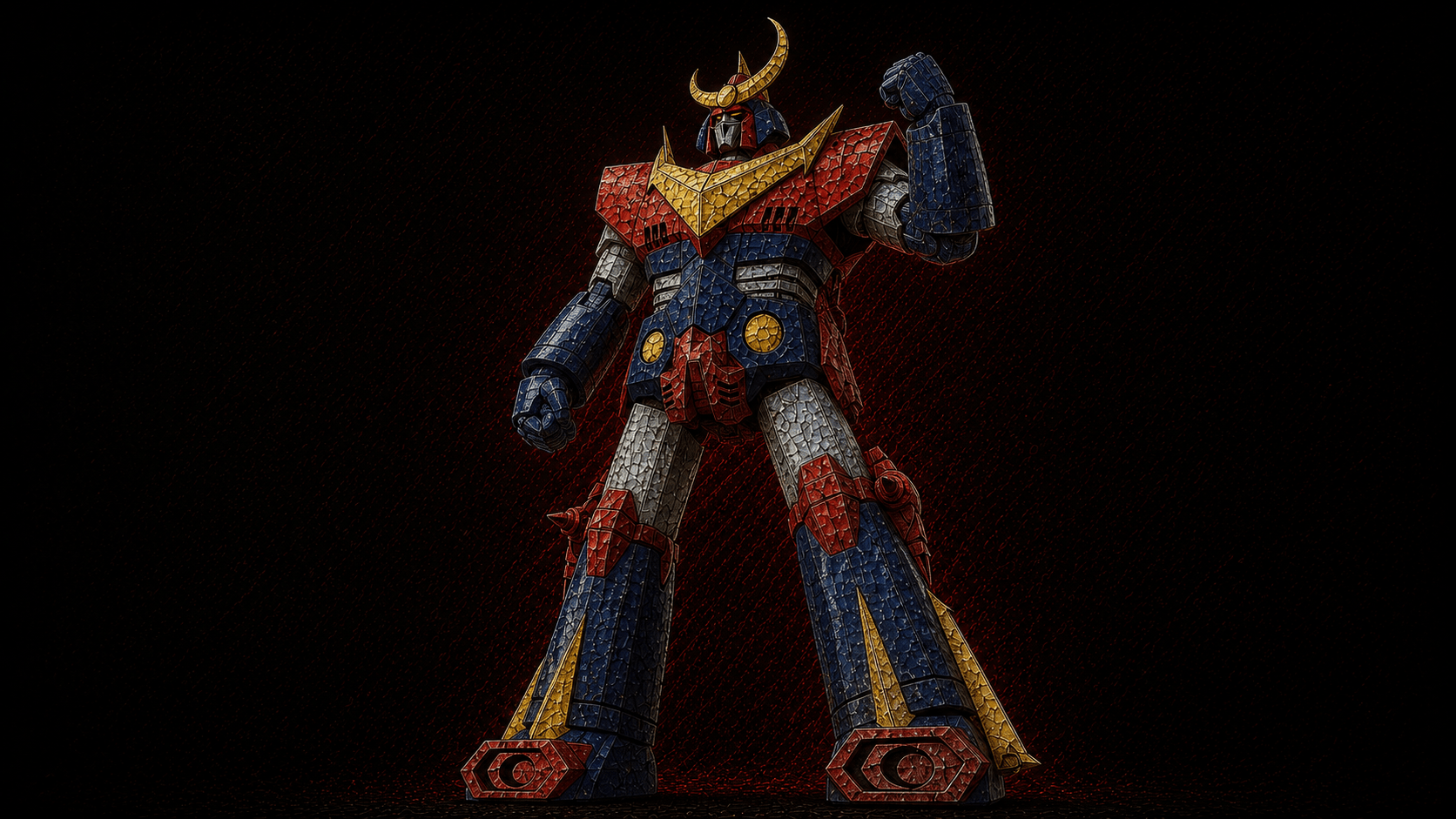
Zambot 3 — Zambird · Zambull · Zambase · Zambot Combination
— Physical Characteristics —
Height
60 meters
Weight
500 tons
Power Output
350,000 horsepower (260 MW)
Energy Source
Ion Energy
Component 1 — Zambird
High-speed aerial vehicle capable of exceeding Japan Self-Defense Force fighter jets; transforms into the humanoid Zambo Ace; forms the head and inner torso of Zambot 3. Height: 30 meters · Weight: 250 tons · Pilot: Kappei Jin
Component 2 — Zambull
Tank-like vehicle with the highest offensive power of the three components; the large fists mounted on top of Zambull become Zambot 3's rocket punches; forms the outer torso and arms. Height: 20 meters · Weight: 250 tons · Pilot: Uchūta Kamie
Component 3 — Zambase
Attack and support vehicle — carries spare ammunition, Zambo Magnums, and reconnaissance drones; oversees power balance distribution throughout Zambot 3; forms the legs. Pilot: Keiko Kamikita
Known Weakness
Armor integrity fails at depths exceeding 7,000 meters underwater
Visual Design Features
- Crescent moon ornament on the forehead — powers the Moon Attack finishing move
- Large rocket fists inherited from Zambull's design
- Wing-like shoulder structures from the Zambird docking
- Leg pods housing the Zambot Buster shuriken weapons
— Combat Characteristics —
Arm Punch
Rocket fists inherited from Zambull's design — Zambot 3's variant of the genre-standard rocket punch, fired and returned in the conventional super robot fashion
Moon Attack
Zambot 3's signature finishing move — energy is gathered from the pilot's hands to the crescent moon ornament on the forehead; a crescent moon-shaped energy projectile is launched at the target, multiplies and surrounds it, then recombines and punches a crescent moon-shaped hole through the enemy. The most powerful weapon in Zambot 3's standard arsenal
Zambot Grapple
A pair of sai weapons that can transform into multiple configurations: joined at the handles to form Zambot Blow (double-sided lance) or Zambot Cutter (sword). The three forms are used consecutively to adapt to different combat situations
Zambot Buster
The leg pods of Zambot 3 are thrown like giant shuriken — typically hitting the enemy twice as they fly outward and return
Buster Missiles
Missiles fired from the same leg pods that house the Zambot Buster
Zambo Magnum
Primary armament of Zambo Ace (Zambird's humanoid mode) — a modular large-caliber gun configurable as a standard magnum, sniper rifle, or rocket launcher depending on the accessories attached
Tremble Horn
Sonic laser weapon fired from the parabolic dish on top of Zambird — used only once in the entire series (episode 6)
Ion Cannon
Zambot 3 can deploy the Ion Cannon from the King Beal — fires a massive lime-green energy beam of significant destructive power
Reconnaissance Mecha Regon
Detachable drone unit from Zambase, used for reconnaissance — deployable both independently and while Zambot 3 is in combined form; used only in episode 21
The Moon Attack's visual design — a crescent moon shape that multiplies, surrounds the enemy, and punches through it — is one of the most distinctive finishing moves in 1970s super robot anime. Unlike the straightforward energy blasts or sword slashes of most contemporaries, the Moon Attack has a surreal, almost geometric quality that anticipates the more abstract combat sequences of later mecha anime.
— Narrative Classification —
Setting
Contemporary Japan — the series begins when the Gaizok alien force arrives on Earth, pursuing the descendants of the planet Beal they previously destroyed
Alignment
Heroic — but perceived as villainous by the civilian population they protect
Central Conflict
The Jin family — descendants of Beal survivors who have lived on Earth for generations — must defend their adopted home against the same Gaizok force that destroyed their original planet. The collateral damage of their battles causes the civilian population to turn against them, blaming the Jin family for attracting the invasion
Primary Antagonist
Killer the Butcher — eccentric but ruthless Gaizok commander operating from the mobile fortress Bandok; responsible for sending Mecha Boost attacks against Japan. Notable for his bizarre behavior — frequently shown indulging in meat, trying on jewelry, and sunbathing — which contrasts sharply with his genuine cruelty
The Human Bomb Arc
From episode 18 onward, Butcher begins converting captured humans into living bombs — a narrative development that shocked audiences in 1977 and remains one of the darkest story arcs in 1970s mecha anime history
Narrative Theme
The cost of being a savior — the Jin family destroys neighborhoods while fighting to save them, loses family members throughout the series, and is publicly blamed for the invasion they are sacrificing everything to stop. The series asks whether protection that causes this much collateral damage is truly protection at all
Ending
Uchūta and Keiko die in a successful suicide attack that destroys the Bandok. Chiyonishiki, Kappei's robot dog, is killed when his cockpit is destroyed. The rest of the Jin family dies when their ship burns up. Kappei is the only survivor — alive, but completely alone. The Gaizok is defeated. The price was everything
— Original TV Series Information —
Title
無敵超人ザンボット3 (Muteki Chōjin Zanbotto Surī)
Broadcast Network
TV Asahi (co-produced with Nagoya TV)
Broadcast Period
October 8, 1977 – March 25, 1978
Episodes
23
Runtime
~25 minutes per episode
Opening Theme
「行け!ザンボット3」(Ike! Zanbot 3) — Ichiro Horimitsu, The Blessin' Four, The Chirps
Ending Theme
「宇宙の星よ永遠に」(Uchuu no Hoshi yo Eien ni) — Ichiro Horimitsu, The Blessin' Four, The Chirps
International Release
- Italy — 1981, regional broadcast only; notably kept the original Japanese theme songs, unusual for Italian anime dubbing of the era
- No North American broadcast release; available with English subtitles through streaming platforms
Home Media
Blu-ray release in Japan; available subtitled through select streaming services internationally
— Main Characters —
Kappei Jin
Primary pilot of Zambird/Zambo Ace and the central hero of the series; 12 years old at the start of the series, impulsive, self-centered, and reckless — the opposite of the conventional noble super robot hero. His arc from arrogant child to someone who has lost everything while saving the world is the emotional spine of Zambot 3. The only member of the team to survive the final battle. Voice: Makio Inoue
Uchūta Kamie
Pilot of Zambull; 13 years old, member of the Kamie family — one of the three Beal survivor families. Dies in the final battle in a successful suicide attack alongside Keiko that destroys the Bandok
Keiko Kamikita
Pilot of Zambase; 14 years old, the only female pilot of the team and member of the Kamikita family. Strong-willed and responsible for Zambot 3's power balance distribution. Dies alongside Uchūta in the final suicide attack
Chiyonishiki
Kappei's pet robot dog — occupies the second cockpit of Zambird throughout the series. His death when his cockpit section is destroyed in the final battle is one of the series' most devastating moments and was unprecedented in children's mecha anime of the era
Killer the Butcher
Primary antagonist and Gaizok commander aboard the Bandok fortress; a genuinely cruel villain whose eccentric behavior — obsessive meat consumption, jewelry trying-on, attempted sunbathing inside his fortress — masks a willingness to use humans as living bombs and execute mass atrocities without hesitation
Shingo Kōzuki
Kappei's civilian rival — a 13-year-old gang leader who is thrust into the conflict despite having no combat role. His perspective as a civilian caught in the destruction caused by Zambot 3's battles provides the series' most direct critique of the "destructive savior" dynamic
— Legacy —
Genre Classification
Super Robot / Mecha deconstruction
Historical Position
The first mecha anime to systematically deconstruct the Super Robot genre — showing civilian casualties, public resentment of robot pilots, and the psychological cost of child soldiers as central narrative elements rather than background details
Known As
- The series where Tomino first became "Kill 'em All Tomino"
- The forgotten ancestor of Neon Genesis Evangelion's deconstruction of mecha anime
- Sunrise's first original production — the series that made the studio
Industry Impact
Zambot 3 established the template for morally complex mecha narratives — heroes who cause damage while protecting, civilians who resent their saviors, and child pilots who bear costs no child should bear. This template runs directly through Gundam (1979), Ideon (1980), and Evangelion (1995). The same creative team — Tomino and Yasuhiko — moved directly from Zambot 3 to Mobile Suit Gundam the following year
Super Robot Wars
Featured in Super Robot Wars 4, Compact 2, Advance, Reversal, Z/Z2/Z3, and 64 — almost always paired with its successor Daitarn 3, with whom it shares combination attacks in the game series
Collector Toys
- Clover diecast toy (1977) — original combining toy produced during the series' run
- Bandai Soul of Chogokin GX-23 (2003) — high-detail anime-accurate version with all three components and Zambo Ace
- King Arts DFS087 Super Machine Zambot 3 (2024) — modern diecast with full transformation and weapon accessories
— Collectibles —
Super Mini PLA Series
Robot Figure ZAMBOT 3
Model Kit 18 cm Trading Figures
Buy on Amazon →