— IDENTITY —
Full Name
Chōdenji Mashīn Borutesu Faibu (超電磁マシーン ボルテスV) — Super Electromagnetic Machine Voltes V
Type
Super Robot / Combining Robot
Creator
Saburō Yatsude (Toei collective pseudonym) · Directed by Tadao Nagahama · Produced by Yoshiyuki Tomino
Debut
1977
Country of Origin
Japan
Original Medium
Anime (original production)
Production Studio
Toei Company (production) · Nippon Sunrise (animation)
Genre
Super Robot / Science Fiction
Also Known As
Voltes V · Voltus 5 · Vultus V · El Ataque Voltes 5 · 초전자머신 볼테스 V
— DEVELOPMENT HISTORY —
Project Designation
Voltes V (originally conceived as Granbuffer Ace and later Chōdenji Robo V.Krieger before the final name was adopted)
Original Designer (Story)
Professor Kentaro Goh (in-universe) · Professor Mitsuyo Goh · Professor Hamaguchi · General Oka
Construction Purpose
Designed and built by Professor Kentaro Goh — a former Boazanian aristocrat — together with his wife and trusted colleagues, as Earth's ultimate defense weapon against the inevitable invasion of the Boazanian Empire
Activation Method
Five component vehicles — Volt Crewzer, Volt Bomber, Volt Panzer, Volt Frigate, and Volt Lander — combine sequentially to form Voltes V. Each vehicle is piloted by one of the five members of the Voltes Team
Historical Significance
The second installment of Tadao Nagahama's Robot Romance Trilogy, following Combattler V and preceding Daimos. Notable for introducing a significantly darker and more dramatic narrative tone than its predecessor, featuring deeply developed enemy characters, a family search storyline, strong themes of social inequality and revolution, and one of the first anime villains with genuine emotional depth and a tragic backstory
— CONTROL SYSTEM —
Primary Operators
- Kenichi Goh — team leader, pilots Volt Crewzer (head unit)
- Ippei Mine — pilots Volt Bomber (arms unit)
- Daijiro Goh — pilots Volt Panzer (body and chest unit)
- Hiyoshi Goh — pilots Volt Frigate (legs unit)
- Megumi Oka — pilots Volt Lander (feet unit)
Control Method
Direct piloting through five independent component vehicles that combine to form the complete robot
Pilot Location
Internal cockpits within each Volt Machine
Cockpit Units
- Volt Crewzer — head
- Volt Bomber — arms
- Volt Panzer — body and chest
- Volt Frigate — legs
- Volt Lander — feet
Autonomy
None
Command Authority
Shared operation under the leadership of Kenichi Goh, requiring coordinated action by all five pilots
Like Combattler V, Voltes V cannot function without the successful combination of all five Volt Machines and their pilots. Unlike its predecessor, however, Voltes V places greater narrative weight on the personal histories and motivations of each team member, making the pilots as central to the story as the robot itself.
— PHYSICAL CHARACTERISTICS —
Robot Class
Combining Giant Humanoid Robot
Body Structure
Five-unit combination system — each Volt Machine forms a distinct structural section of the complete robot
Head Design
Armored helmet with small gold horns, central gold spike, and red visor with amber glowing eyes
Visual Characteristics
- Dark navy blue armored body
- White torso and waist section
- Bold red X-shaped chest marking with gold circular center
- Hexagonal gold belt buckle
- Red accent lines on arms and legs
- Heroic humanoid proportions
- Visible combination seams from the five-machine transformation system
— POWER SYSTEM —
Primary Energy Source
Chōdenji Energy (Super Electromagnetic Energy)
Armor Material
Chōdenji Alloy — later upgrades include Maxingal-resistant reinforcements developed in response to Boazanian weapon advancements
Material Origin
Developed using advanced Boazanian science adapted by Professor Kentaro Goh for Earth's defense
Energy Concept
Super Electromagnetic Energy powers all of Voltes V's combat systems and forms the basis of its signature finishing attacks, including the Chōdenji Ball upgrade to the Tenkūken sword
— COMBAT CHARACTERISTICS —
Primary Combat Style
- Close-quarters swordsmanship
- Electromagnetic weapon attacks
- Heavy artillery and missile barrages
- Aerial and multi-environment engagement
Signature Weapons
- Tenkūken (Heaven Sword / Laser Sword) — primary finishing weapon; delivers the iconic V-slash
- Chōdenji Top (Super Electromagnetic Top)
- Chōdenji Ball — electromagnetic upgrade for the Tenkūken
- Volt Bazooka
- Ultra Electromagnetic Beam
- Electromagnetic Whip
- Volt Fire
- Gatling Missiles
Mission Profile
- Defense of Earth against the Boazanian Beast Knight invasion
- Protection of Camp Big Falcon and the Earth International Defense Force
- Counteroffensive operations culminating in the liberation of planet Boazan
Operational Environment
- Land
- Sea
- Air
- Near-space and interplanetary operations
Voltes V marked one of the first instances of a super robot using a sword as its primary finishing weapon, with the Tenkūken's signature V-slash becoming one of the most iconic attack sequences in the Super Robot genre. The gun-based finishing attack originally planned for the series was changed to a sword at the request of Sunrise and Toei during development.
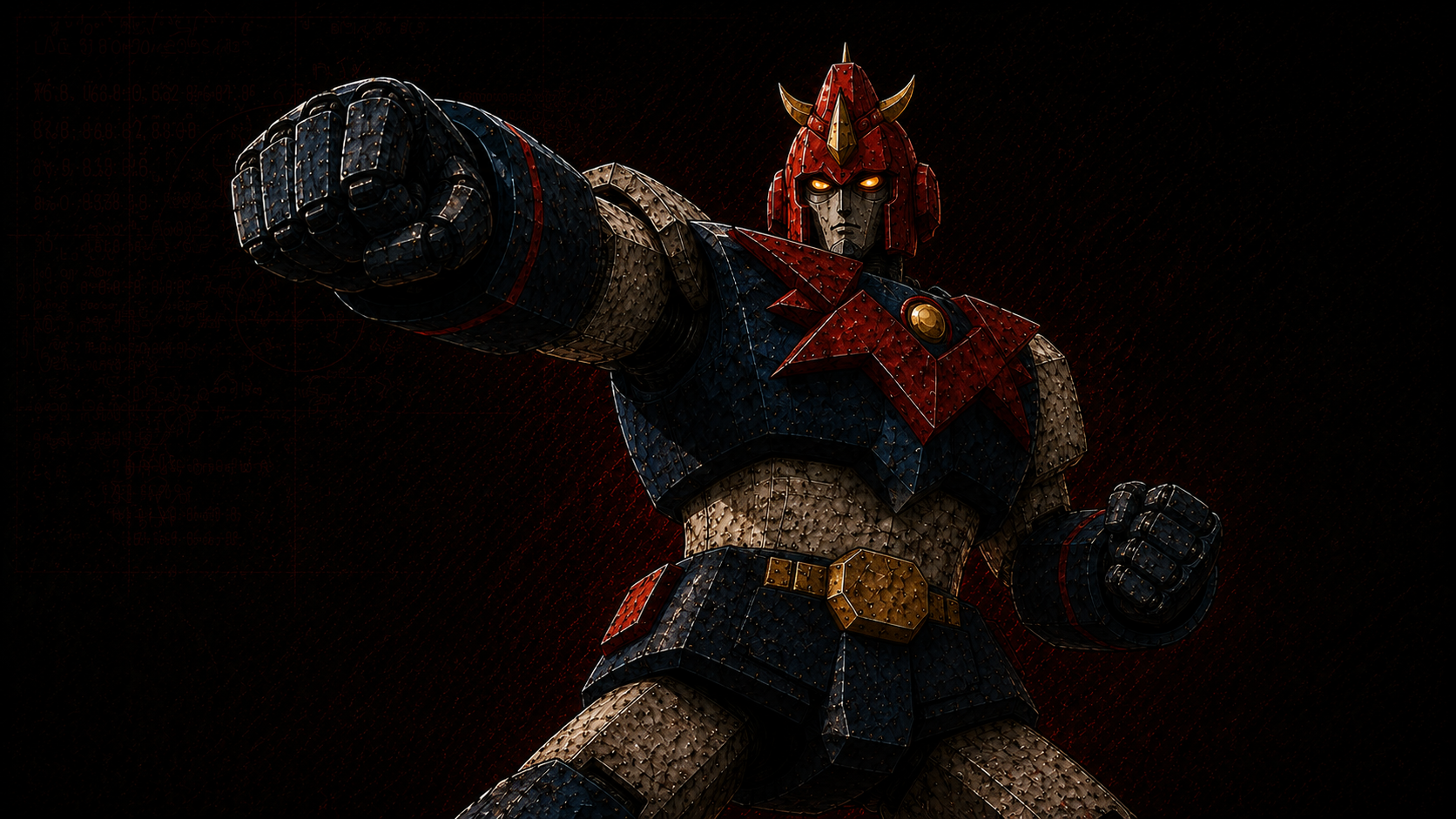
Voltes V — Tenkūken · Let's Volt In
— ASSOCIATED ORGANIZATIONS —
Affiliation
Earth International Defense Force — Camp Big Falcon
Base of Operations
Camp Big Falcon — a top-secret fortress base located on the hidden island of Ootorijima
Role
Earth's primary defense weapon against the Boazanian Imperial invasion
Primary Enemy
Emperor Zu Zambajil
Enemy Organization
Boazanian Empire
Major Threats
- Emperor Zu Zambajil — supreme ruler of Boazan
- Prince Heinel — commander of the Boazanian Earth invasion force
- Zuhl — Boazanian science officer and inventor of the Anti-Super Electromagnetic Device
- Do Bergan — second Boazanian general, introduced Maxingal alloy armor
- General Gururu — head of the Boazanian military
- Beast Knights (Jūsenki) — biomechanical monster weapons deployed by the Boazanians
— ORIGINAL MANGA INFORMATION —
Note
Voltes V was conceived as an anime project first. Manga adaptations were published concurrently with the anime broadcast and were not the original source material
Publisher
Kodansha (TV Magazine) and other publications
Country
Japan
— ORIGINAL TV SERIES INFORMATION —
Title
Chōdenji Mashīn Borutesu Faibu (超電磁マシーン ボルテスV)
Broadcast Period
June 4, 1977 – March 25, 1978
Episodes
40
Network
TV Asahi
Production Company
Toei Company (production) · Nippon Sunrise (animation)
Director
Tadao Nagahama
Producer
Yoshiyuki Tomino
Runtime
Approximately 25 minutes per episode
International Releases
- Philippines: premiered on GMA Network on May 5, 1978; banned by President Marcos on August 27, 1979 with four episodes unaired; re-aired after the 1986 People Power Revolution
- USA: Shogun Warriors toy line (Mattel, late 1970s) · Voltus 5 compilation release (1983)
- Italy, Spain: broadcast and home video releases under various titles
- Cuba, Indonesia: broadcast in the 1980s
- North America: DVD/Blu-ray with English subtitles licensed by Discotek Media
- Philippines live-action adaptation: Voltes V: Legacy (GMA Network, May–September 2023)
— MAIN CHARACTERS —
Kenichi Goh
Leader of the Voltes Team and pilot of Volt Crewzer (head unit); eldest of the three Goh brothers, a marksman and motocross champion whose responsible nature was forged by his father's disappearance
Ippei Mine
Pilot of Volt Bomber (arms unit); a rodeo champion orphaned as a child, known for his cynical disposition and fierce rivalry with Kenichi that gradually evolves into deep mutual respect
Daijiro Goh
Pilot of Volt Panzer (body and chest unit); second Goh brother, a martial arts master whose personality hardened after his father's disappearance
Hiyoshi Goh
Pilot of Volt Frigate (legs unit); youngest Goh brother, a 10-year-old genius in robotics and electromagnetism who serves as the team's technical specialist
Megumi Oka
Pilot of Volt Lander (feet unit); daughter of Commander Oka and the 18th heir of the Kōga-ryū ninja tradition; the only female member of the Voltes Team and the team's voice of reason
— LEGACY —
Historical Position
One of the defining super robot series of the late 1970s and a landmark work in combining robot history; the second installment of Tadao Nagahama's Robot Romance Trilogy
Genre Innovation
Elevated the narrative ambition of the Super Robot genre by introducing deeply developed antagonists with genuine emotional backstories, serialized family drama, and strong themes of social inequality and revolution — setting a new standard for character-driven storytelling in mecha anime. Also established the sword-based finishing attack as a genre convention, with the Tenkūken's V-slash becoming one of the most imitated moves in super robot history
Relationship to Previous Mecha
Conceived by Tadao Nagahama as a spiritual sequel to Combattler V, sharing its five-pilot combination format while dramatically expanding the narrative depth, dramatic stakes, and character development beyond anything seen in its predecessor
Industry Impact
Influenced a generation of mecha productions through its darker tone, serialized storytelling, and humanized villain characters. Appeared in the Super Robot Wars video game franchise beginning with Shin Super Robot Wars (PlayStation, 1996). Inspired a Philippine live-action adaptation, Voltes V: Legacy, in 2023 — one of the most expensive television productions in Philippine history
International Recognition
Achieved the status of a national cultural phenomenon in the Philippines, where its 1979 ban by President Marcos became politically charged and its eventual return after the 1986 People Power Revolution was celebrated as a symbol of restored freedom. Also achieved significant popularity in Cuba, Indonesia, Italy, and Spain. Widely regarded as one of the greatest super robot anime ever produced and a cornerstone of the genre's golden era
— OPENING —
— COLLECTIBLES —
Bandai Spirits — The Robot Spirits
Voltes V Legacy
The Robot Spirits Action Figure
Buy on Amazon →