
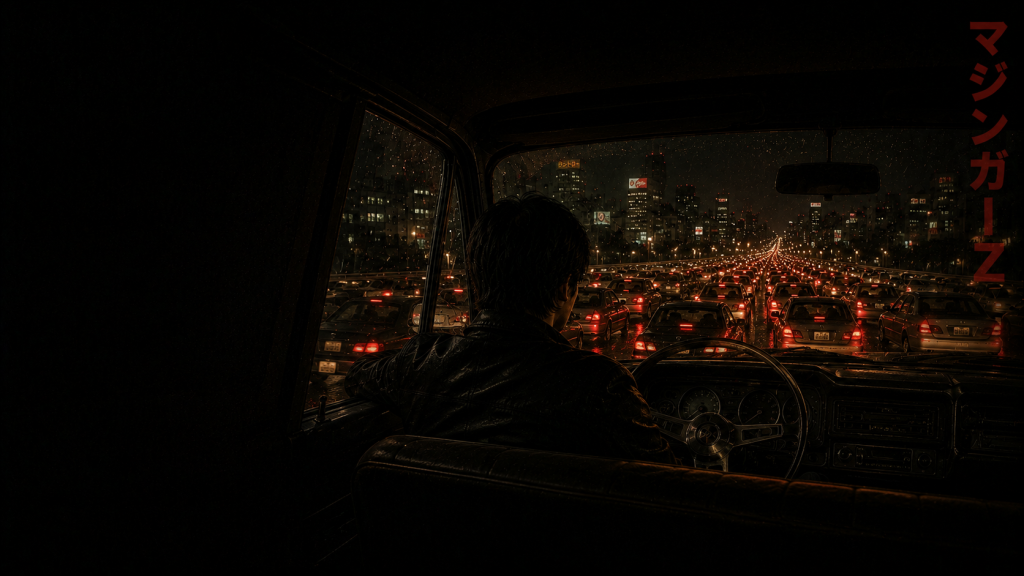
In 1972, Go Nagai was stuck in a traffic jam in Tokyo. As cars piled up around him, he had a thought that seems almost too simple: what if a car could just walk over the others?
That single image — a machine that carries its operator inside and moves through the world on its own terms — became the conceptual seed of Mazinger Z. When the series premiered on Fuji TV on December 3, 1972, it introduced something that had never existed in anime before: a giant robot piloted from an internal cockpit.
Before Mazinger Z, giant robots in anime were either autonomous beings (like Astro Boy) or remote-controlled machines (like Tetsujin 28-go). The pilot was always outside, always separate. Go Nagai collapsed that distance. He put Koji Kabuto inside the machine, docking his hovercraft directly into Mazinger Z’s head, and in doing so invented a new relationship between human and robot that would define the mecha genre for the next five decades.
The idea that a robot is not just a weapon but an extension of its pilot — that the machine feels what the pilot feels, moves as the pilot moves, and in some sense becomes the pilot — traces directly back to that Tokyo traffic jam in 1972.
Every cockpit in every mecha series since then is Go Nagai’s idea. Gundam. Evangelion. Gurren Lagann. Pacific Rim. All of them begin with a person climbing inside a machine and becoming something larger than themselves. And it all started with one man imagining a car that could walk.