— IDENTITY —
Full Name
VF-1 Valkyrie
Featured In
Super Dimension Fortress Macross (超時空要塞マクロス), 1982
Debut
October 3, 1982
Studio
Studio Nue, Artland, Tatsunoko Production
Network
Mainichi Broadcasting System (MBS)
Chief Director
Noboru Ishiguro
Character Design
Haruhiko Mikimoto
Mechanical Design
Shoji Kawamori, Kazutaka Miyatake
Original Concept
Shoji Kawamori
Classification
Real Robot — Variable Fighter type
— DEVELOPMENT HISTORY —
Franchise Position
First entry of the Macross metaseries, and the opening installment of the "Super Dimension Trilogy" (alongside Super Dimension Century Orguss and Super Dimension Cavalry Southern Cross), all sponsored by Big West
Production Expansion
Originally planned for 13 episodes, the series was extended to 23 and finally to 36 due to strong fan support and merchandise sales
Together with Mobile Suit Gundam, Macross helped move anime mecha away from invincible "superhero" robots toward "Real Robots" — machines that required maintenance and could run out of fuel. Its young production crew, many in their early twenties, set it apart from contemporaries like Space Battleship Yamato and Gundam, whose staff were comparatively more experienced.
— CONTROL SYSTEM —
Primary Pilot
Hikaru Ichijyo, an inexperienced civilian pilot thrust into combat aboard the SDF-1 Macross
Transformation Modes
- Fighter — jet aircraft configuration
- GERWALK — hybrid half-jet, half-humanoid configuration
- Battroid — full humanoid combat configuration
— PHYSICAL CHARACTERISTICS (VF-1 VALKYRIE) —
Height
12.68 m (Battroid mode), 8.7 m (GERWALK mode), 3.84 m (Fighter mode)
Weight
13.25 tons empty, 18.5 tons standard takeoff mass
Wingspan
14.78 meters (fully extended, Fighter mode)
Design Inspiration
Grumman F-14 Tomcat (variable-sweep wings) and McDonnell Douglas F-15 Eagle, with its name honoring the real-world XB-70 Valkyrie bomber
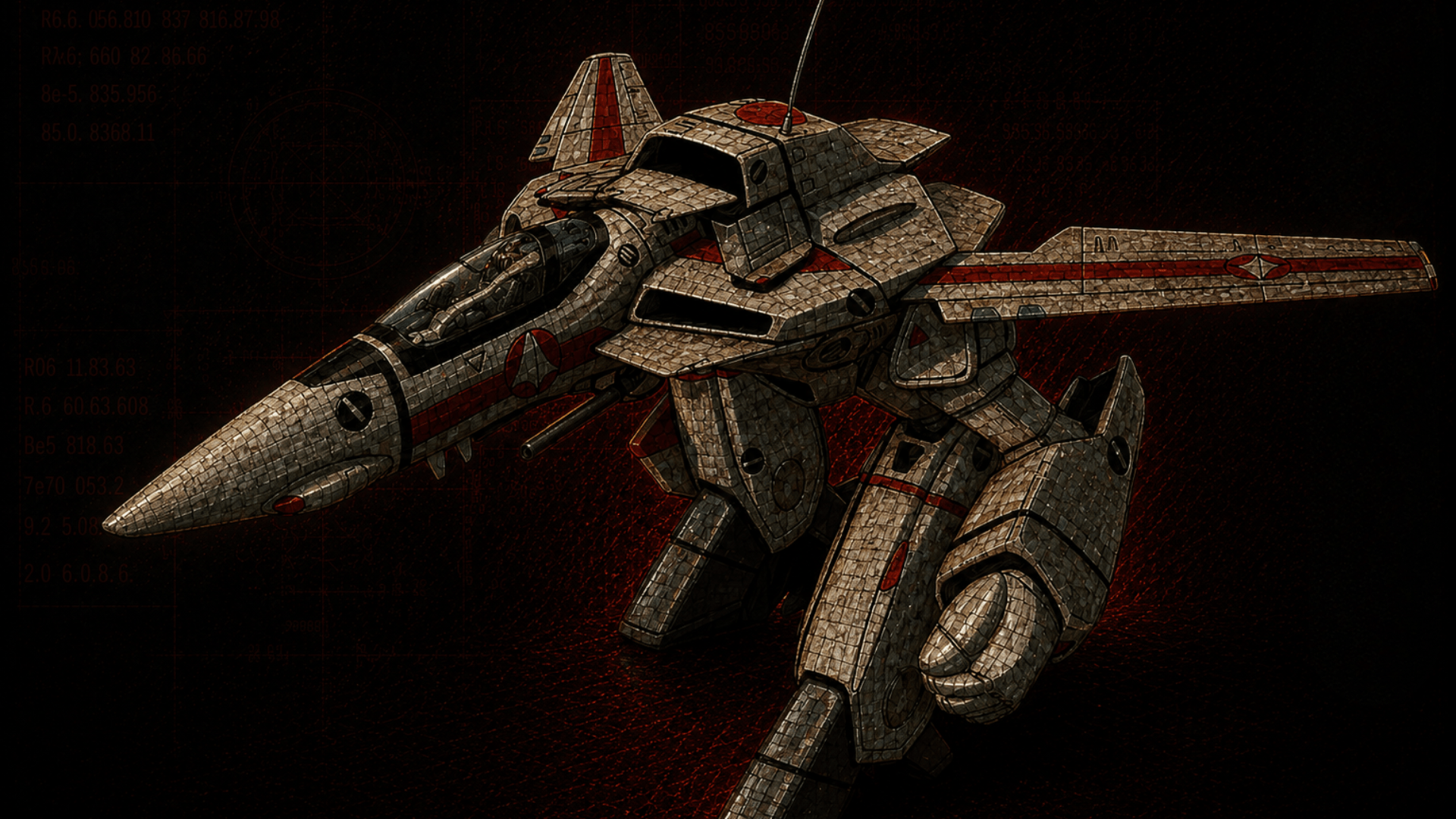
The VF-1 Valkyrie, transformed into GERWALK Mode
— COMBAT CHARACTERISTICS —
Primary Weapon
Howard GU-11 55mm three-barrel Gatling gun pod
Fixed Weaponry
Mauler laser cannon, head-mounted, for point-defense against missiles and small targets
Powerplant
2x Shinnakasu Heavy Industry thermonuclear reaction turbine engines
Notable Enemy Forces
The Zentradi — a warrior race of humanoid giants roughly five times the size of a human, native to the alien empire that built the SDF-1
— ASSOCIATED ORGANIZATIONS —
U.N. Spacy
Earth's unified space defense force, formed after the crash of the alien vessel later rebuilt as the SDF-1 Macross, tasked with developing the Valkyrie to counter the Zentradi threat
The Zentradi
A warlike alien race of giant humanoids who identify the Macross as an enemy warship, igniting Space War I
— TV SERIES INFORMATION —
Broadcast
Mainichi Broadcasting System (MBS), October 3, 1982 – June 26, 1983
Episodes
36
Theatrical Adaptation
The Super Dimension Fortress Macross: Do You Remember Love? (1984)
Despite its now-legendary status, Macross aired in a low-rated Sunday 2:00 PM timeslot in Tokyo and averaged just 6.4% viewership — though regional broadcasts, like Yamagata TV's Wednesday evening slot, drew ratings as high as 36%. It shared the Animage Anime Grand Prix's top award for Best TV Series in 1982 with Six God Combination GodMars.
— MAIN CHARACTERS —
Hikaru Ichijyo
A civilian pilot drawn into the war when he test-flies a VF-1 Valkyrie during the Zentradi's first assault, becoming caught in a love triangle between Misa Hayase and Lynn Minmay
Misa Hayase
Bridge officer aboard the SDF-1 Macross, whose strained professional relationship with Hikaru develops into romantic tension over the course of the series
Lynn Minmay
An aspiring singer aboard the Macross whose music becomes a cultural phenomenon among both humans and Zentradi, ultimately playing a decisive role in ending the war
Roy Focker
Veteran U.N. Spacy pilot and commander of Skull Squadron, who mentors Hikaru and carries on a romance with Claudia LaSalle
— LEGACY —
Genre Classification
Real Robot — Variable Fighter type
Franchise Legacy
Launched the ongoing Macross metaseries, with sequels including Macross 7, Macross Frontier, and Macross Delta continuing to the present day
International Adaptation
Adapted by Harmony Gold as the first saga of Robotech (1985), a heavily altered Western localization; Shoji Kawamori has publicly disowned Robotech as a "pirated version" of his work
Genre Influence
Its transforming Valkyrie design sparked a "transformation boom" across the Real Robot genre, directly influencing later works including Aura Battler Dunbine and Mobile Suit Zeta Gundam
— OPENING —
— COLLECTIBLES —