— Identity —
Full Name
RX-78-2 Gundam (RX-78-2 ガンダム) — Mobile Suit Gundam
Type
Real Robot / Prototype Close Combat Mobile Suit
Creator (in-universe)
Tem Ray — engineer of the Earth Federation's secret Project V (Operation Victory)
Creator (real world)
Yoshiyuki Tomino (series creator) · Kunio Okawara (mecha designer) · Hajime Yatate (Sunrise collective pseudonym)
Debut
1979
Country of Origin
Japan
Original Medium
Anime (original production)
Production Studio
Sunrise
Genre
Real Robot / Military Science Fiction
Model Number
RX-78-2 — "R" denotes Federation model; "X" indicates experimental; "78" denotes the line established in UC 0078; "2" identifies it as the second prototype in the series
Also Known As
The White Devil (by Zeon forces) · Gundam 0079 · First Gundam
— Development History —
Development Program
Project V (Project Victory) — a top-secret Earth Federation initiative to develop mobile weapons capable of countering the Principality of Zeon's mobile suit forces, initiated four years before the One Year War
Lead Engineer
Tem Ray — assembled the RX-78-2 at the Federation's research base in the space colony Side 7
Mecha Designer
Kunio Okawara — created multiple design concepts before settling on the final samurai-styled aesthetic. Sunrise insisted on brighter colors over Tomino's original grayscale concept to match the super robot aesthetic of the era
Series Creator
Yoshiyuki Tomino — conceived the series originally as Freedom Fighter Gunboy, featuring a powered armor concept. The series was renamed Mobile Suit Gundam during production
Original Concept
The RX-78's initial concept was a powered armor suit. As the series evolved, it became a full-scale mobile suit — a paradigm shift that defined the Real Robot genre
Historical Significance
The RX-78-2 Gundam is the robot that ended the Super Robot era and launched the Real Robot genre. For the first time in mecha anime, a giant robot was presented not as a mythological weapon of a chosen hero, but as a military prototype — a machine of war with technical limitations, maintenance requirements, and a pilot who was not born to pilot it. Everything that followed in the mecha genre was shaped by this shift
Production Context
Mobile Suit Gundam premiered on April 7, 1979, on Nagoya Broadcasting Network. Initial ratings were poor and the series was cut to 43 episodes from a planned 52. It was the rerun broadcasts and the 1980 Bandai Gunpla (plastic model) line that transformed it into a cultural phenomenon
Mobile Suit Gundam premiered to disappointing ratings and was cancelled before completing its planned run. It was the rebroadcast — and above all, the Gunpla model kits released by Bandai in 1980 — that created the phenomenon. By 1981, three theatrical compilation films had been released to packed cinemas. The series that nearly failed on first broadcast went on to become the most commercially successful mecha franchise in history, with over 750 million Gunpla units sold worldwide by 2026.
— Control System —
Primary Pilot
Amuro Ray — civilian teenager, son of engineer Tem Ray; accidental pilot who discovered the Gundam during the Zeon attack on Side 7 and taught himself to operate it in combat
Control Method
Direct internal piloting via conventional controls — levers, pedals, and a panoramic monitor cockpit. No neural link, no special powers required for basic operation
Core Block System
The cockpit is housed in the FF-X7 Core Fighter — a small spacecraft that can separate from the Gundam's torso in an emergency, preserving the pilot and securing combat data
Learning Computer
An onboard artificial intelligence that collects and analyzes combat data from each battle, progressively optimizing the Gundam's performance and anticipating the pilot's commands. Combat data from the RX-78-2 was later used to develop the mass-produced RGM-79 GM
Newtype Compatibility
As Amuro's latent Newtype abilities developed, his reaction speed eventually surpassed the Gundam's mechanical response limits — requiring a magnetic coating upgrade on the joints to keep pace with his reflexes
Magnetic Coating Upgrade
Applied before the Battle of A Baoa Qu by technician Mosque Han — a special membrane treatment on the joint systems that dramatically increased response speed to match Amuro's Newtype reaction time
Carrier Vessel
White Base (Pegasus-class assault carrier) — the Gundam's mobile base of operations throughout the One Year War
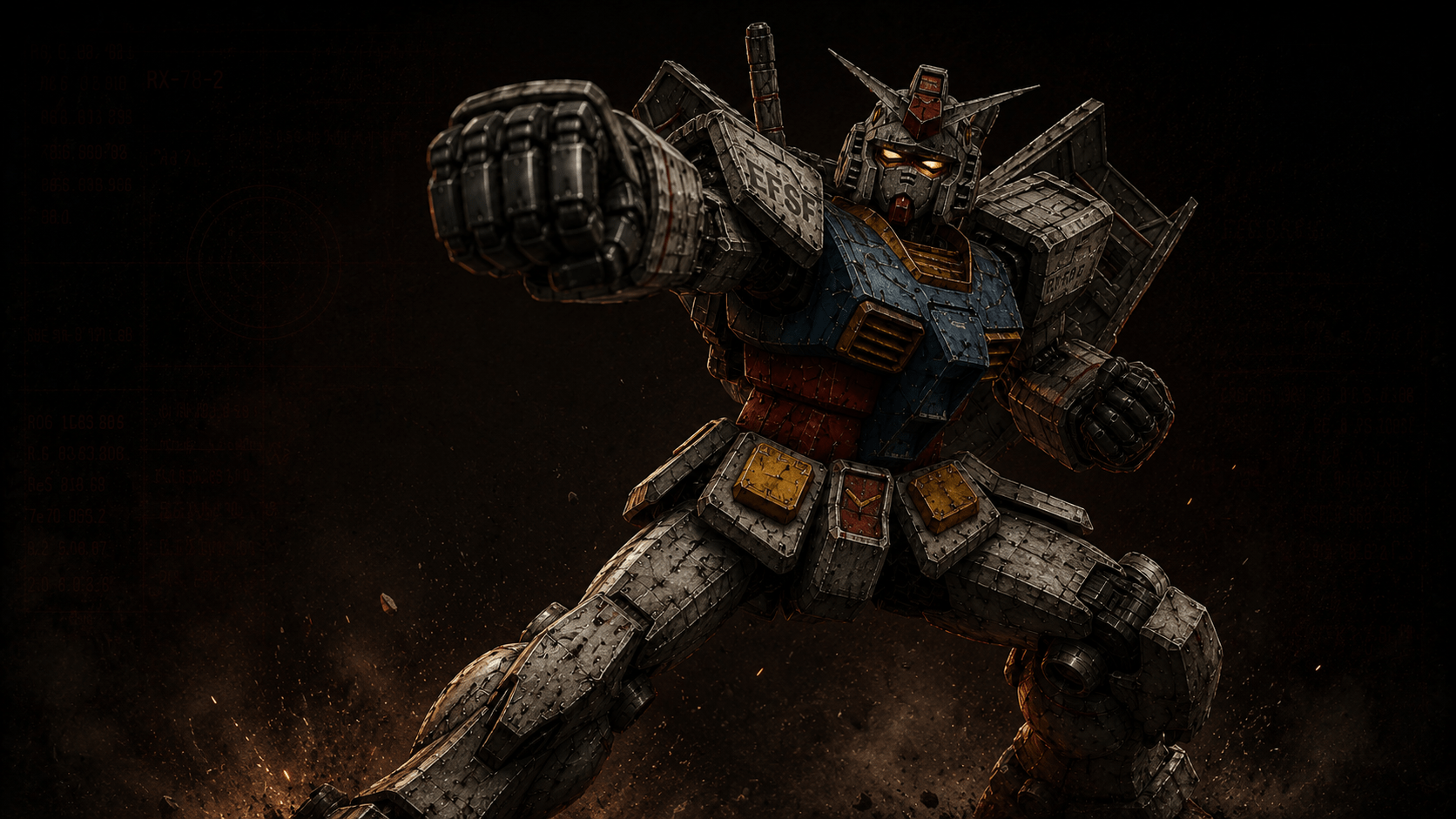
RX-78-2 Gundam — the White Devil of the One Year War
— Physical Characteristics —
Height
18.0 meters
Weight (empty)
43.4 tons
Weight (maximum)
60 tons
Power Plant
Minovsky-type ultracompact fusion reactor — output rated at 1,380 kW
Armor Material
Luna Titanium Alloy (later renamed Gundarium) — lighter than conventional titanium, yet significantly more durable than Zeon's mass-produced mobile suit armor. Capable of withstanding MS-06 Zaku II machine gun fire with minimal damage
Maximum Speed (ground)
165 km/h
Color Scheme
White, blue, red, and yellow — originally conceived as grayscale by Tomino; Sunrise insisted on brighter colors consistent with super robot anime of the period
Visual Design Features
- V-fin antenna on the head — became the defining symbol of the Gundam franchise
- Yellow chest vents — thermal regulation and sensor systems
- Panoramic cockpit in the torso Core Block
- Back-mounted rocket thrusters for atmospheric and space flight
- Beam saber storage ports in the backpack
Re-entry System
Heatproof Film — stored in a capsule at the waist, deployed to cover the Gundam during atmospheric re-entry to counter frictional heat
— Combat Characteristics —
Combat Classification
Prototype close-combat mobile suit — designed for versatility across ranged and melee engagements
Beam Rifle
BAUVA XBR-M-79-07G — the first portable beam weapon ever produced. Output: 1.9 megawatts. Firepower equivalent to a battleship's main cannon. Fires charged Minovsky particles via E-cap technology. 12–15 shots per charge. Can be stored on the back of the waist when not in use
Beam Sabers
Two beam sabers stored in the backpack — the first beam-based melee weapons in the Universal Century. Plasma blades composed of Minovsky particles held in an I-field; capable of cutting through virtually any material
60mm Vulcan Guns
Twin three-barrel vulcan cannons mounted in the head — used for close and mid-range defense, and for targeting fast-moving missiles and light targets
Hyper Bazooka
Optional large-caliber rocket launcher — 6-round payload, effective against heavy armor and fortified positions
Gundam Hammer
Optional spiked flail weapon — a throwback to super robot-era aesthetics, used in early episodes before the beam rifle became the primary weapon
Shield
Luna Titanium alloy tower shield — primary defensive equipment, capable of blocking beam fire and physical impacts
Gyro Spinner
Super Napalm launcher — 4-tube rocket launcher optionally mounted below the beam rifle barrel, firing powerful napalm rounds
G-Fighter
Optional support unit — a modular fighter craft that interfaces with the Gundam's Core Block System to create multiple combined configurations including the G-Armor assault bomber and G-Bull support tank
The Beam Rifle was a revolutionary concept in 1979 — a handheld weapon with the destructive output of a battleship's main gun. In the super robot era, weapons were fantastical (Rocket Punch, Breast Fire, Tenkūken). The Beam Rifle was presented as credible military technology with ammunition limits, recharge requirements, and tactical considerations. This single design choice captured the entire philosophical shift between the Super Robot and Real Robot genres.
— Narrative Classification —
Setting
Universal Century 0079 — a future where humanity has colonized space in orbital colonies called Sides. The Principality of Zeon, a colony nation, declares independence from the Earth Federation and initiates the One Year War
Alignment
Earth Federation Forces
Primary Pilot
Amuro Ray — a 15-year-old civilian with no military training who becomes the Federation's most feared pilot through innate Newtype abilities and the Gundam's learning computer
Primary Antagonist
Char Aznable — ace pilot of the Principality of Zeon, known as the Red Comet; Amuro's primary rival throughout the series
Central Conflict
The One Year War — a conflict between the Earth Federation and the Principality of Zeon, fought primarily in space with mobile suits as the dominant weapon of war. The RX-78-2 serves as the Federation's decisive technological advantage
Narrative Theme
War as a human tragedy — neither side is purely heroic or villainous. Zeon pilots are given depth and humanity; Federation command is often cynical and self-serving. Amuro's psychological deterioration under combat stress was unprecedented in the mecha genre
Fate of the Gundam
Destroyed near the end of the One Year War during the Battle of A Baoa Qu — Amuro escapes in the Core Fighter. The Gundam's combat data was incorporated into the mass-produced RGM-79 GM series
— Original TV Series Information —
Title
機動戦士ガンダム (Kidō Senshi Gandamu) — Mobile Suit Gundam
Broadcast Network
Nagoya Broadcasting Network (TV Asahi affiliate network)
Broadcast Period
April 7, 1979 – January 26, 1980
Episodes
43 (cut from planned 52 due to initial low ratings)
Runtime
~25 minutes per episode
Director
Yoshiyuki Tomino
Character Designer
Yoshikazu Yasuhiko
Mecha Designer
Kunio Okawara
Opening Theme
「翔べ! ガンダム」(Tobe! Gundam / Fly! Gundam) — Koh Ikeda
Ending Theme
「いまはおやすみ」(Ima wa Oyasumi / Now Rest) — Koh Ikeda
Theatrical Films
- Mobile Suit Gundam (compilation film 1) — February 22, 1981
- Mobile Suit Gundam II: Soldiers of Sorrow — July 11, 1981
- Mobile Suit Gundam III: Encounters in Space — March 13, 1982
International Release
- Italy — first international broadcast, TMC, February 1980
- USA — English dub by Ocean Group; premiered on Cartoon Network Toonami, July 23, 2001
- Philippines, Spain, Latin America — various broadcast windows through the 1980s and 1990s
- North America — Bandai Entertainment home video; later Sunrise/Bandai Namco streaming licenses
— Main Characters —
Amuro Ray
Primary pilot of the RX-78-2; a 15-year-old civilian mechanic living on the space colony Side 7, son of Project V engineer Tem Ray. Discovers the Gundam during the Zeon attack and pilots it in combat with no military training. His latent Newtype abilities gradually manifest, making him the most effective mobile suit pilot of the One Year War. Known to Zeon forces as the White Devil. Voice: Tohru Furuya
Char Aznable
Commander in the Principality of Zeon and Amuro's primary antagonist; known as the Red Comet for destroying five Federation warships in under five minutes at the Battle of Loum. Pilots the red MS-06S Zaku II and later the MSN-02 Zeong. His true identity — Casval Rem Deikun, son of the slain Zeon leader Zeon Zum Deikun — and his personal vendetta against the Zabi family drives a hidden agenda beneath his military role. Voice: Shūichi Ikeda
Bright Noa
Commanding officer of the White Base; a 19-year-old ensign who assumes command after the original senior officers are killed during the Side 7 attack. Grows from a junior officer into one of the Federation's most capable commanders over the course of the war
Sayla Mass
Communications officer of the White Base; secretly Artesia Som Deikun, Char Aznable's younger sister. Her dual loyalty — to the White Base crew and to her brother — creates a persistent narrative tension throughout the series
Lalah Sune
A powerful Newtype discovered and trained by Char Aznable; pilot of the MAN-08 Elmeth mobile armor. Her relationship with both Char and Amuro, and her death in battle, becomes the defining emotional turning point of the series and a catalyst for the rivalry between the two protagonists that continues across subsequent Gundam installments
Garma Zabi
Youngest son of the Zabi family and commander of Zeon's Earth Attack Force; considered a friend by Char Aznable, who betrays him to his death as part of his long revenge against the Zabi dynasty
— Legacy —
Genre Classification
Real Robot — the genre Gundam created and defined
Historical Position
The most consequential single work in the history of mecha anime — the series that ended the Super Robot era and established the Real Robot genre as the dominant paradigm for the decade that followed
Known As
- The series that invented the Real Robot genre
- The origin of the Gundam franchise — the most commercially successful mecha property in history
- The anime that created Gunpla — the plastic model kit industry that generated over 750 million units sold
Industry Impact
Mobile Suit Gundam redefined what a mecha anime could be. War was portrayed as politically complex, morally ambiguous, and psychologically costly. Robots were weapons, not gods. Enemies had names, faces, and motivations. The series directly inspired Macross (1982), Evangelion (1995), and effectively every serious mecha production of the past four decades. The Gunpla model kit line, launched by Bandai in 1980, became one of the most successful toy lines in history and continues to drive annual revenue of billions of dollars
Awards
Won the Animage Anime Grand Prix in 1979 and 1980 — the first two years the award was held
Franchise Scope
The original series launched a franchise spanning over 50 anime productions, dozens of manga and novel series, and the Gunpla model kit line — one of the largest and most enduring media franchises in Japanese history
Collector Models
- HG (High Grade) RX-78-2 — entry-level, 1/144 scale
- MG (Master Grade) RX-78-2 Ver. 3.0 — 1/100 scale, full inner frame
- RG (Real Grade) RX-78-2 — 1/144 scale with advanced internal structure
- PG (Perfect Grade) RX-78-2 — 1/60 scale, LED eyes, full mechanical interior
- PG Unleashed RX-78-2 — ultimate collector version with unprecedented mechanical detail
— OPENING —
— Collectibles —
Bandai Hobby MG Gundam
1/100 Scale Figura De Acción Modelo Kit
RX-78 – 2 VER. 3.0
Buy on Amazon →