— Identity —
Full Name
無敵ロボ トライダーG7 (Muteki Robo Toraidā Jī Sebun) — Invincible Robo Trider G7
Also Known As
Tryder G7 · Bird Attack Tryder G7 · Unchallengeable Trider G7 · L'Indistruttibile Robot Trider G7 (Italy)
Type
Super Robot / Multi-mode transformable mecha
Creator (in-universe)
Professor Nabalon (a scientist exiled from the Robot Empire) and Michitarō Takeo (former president of the Takeo General Company) — designed together as Earth's defense against the inevitable Robot Empire invasion
Creator (real world)
Hajime Yatate (Sunrise collective pseudonym) · Mecha design by Kunio Okawara and Yutaka Izubuchi · Character design by Nobuyoshi Sakamoto
Debut
1980
Country of Origin
Japan
Original Medium
Anime (original production)
Production Studio
Sunrise
Genre
Super Robot / Comedy / Coming-of-age / Science Fiction
Series Position
Third installment of the Sunrise "Invincible Series" — following Zambot 3 (1977) and Daitarn 3 (1978). Often grouped with those two series as the "Invincible Trilogy," though Trider G7 was not directed by Tomino
— Development History —
Director
Katsutoshi Sasaki — not a Yoshiyuki Tomino production, though Tomino directed episode 5 and provided storyboard assistance
Screenwriter
Hiroyuki Hoshiyama — credited with elevating the series above standard super robot fare through warm, character-driven storytelling and black comedy around the company's financial struggles
Origin of Concept
The series was developed as a response to Mobile Suit Gundam's success — Sunrise noted that while Gundam attracted older anime fans, it failed to reach young children. Trider G7 was designed to fill that gap with a more accessible, comedy-infused super robot format aimed at younger audiences
Invincible Series Connection
Shares the "Muteki" (無敵, Invincible) prefix with Zambot 3 and Daitarn 3, creating the "Invincible Trilogy" of Sunrise super robot series. Characters from Daitarn 3 (Banjō Haran) and Zambot 3 appear as cameos in Trider G7
Unique Premise
The first super robot anime to place its hero in a business management context — Watta must balance piloting a giant robot with running a small company, managing employees twice his age, maintaining the robot's operating costs, and attending elementary school simultaneously
Financial Comedy
A recurring black comedy element: the company accountant Kakikōji calculates the cost of every missile fired during battle in real time, creating running jokes about the financial sustainability of robot combat. The company charges clients for each deployment — robot defense as a paid service
Storage Location
Trider G7 is stored beneath a public children's playground — its head serves as a jungle gym attraction for local children. When Trider G7 is deployed, a broadcast announcement is made to evacuate the playground before launch
Toy Production
Toys produced by Clover — the same company that produced toys for Zambot 3 and Daitarn 3. No toy version ever fully replicated all seven transformation modes of the robot
Trider G7 is one of the most tonally unique super robot series of its era — a show that treats giant robot combat as a legitimate business expense, complete with invoices, repair bills, and an accountant who screams at Watta every time he fires a missile. Beneath the comedy, however, is a genuinely warm coming-of-age story about a 12-year-old boy grieving his father while trying to honor his memory by keeping the company alive. It is one of the few super robot series where the emotional core has nothing to do with saving the world and everything to do with growing up.
— Control System —
Primary Pilot
Watta Takeo — 12 years old, sixth grade elementary school student, second president of the Takeo General Company; the only person capable of piloting Trider G7
Control Method
Direct single-pilot operation from inside the robot's cockpit; Watta controls all transformation modes and weapons independently
Deployment Protocol
Before each sortie, a public broadcast announcement is made to evacuate the playground above Trider G7's underground hangar. The robot only launches after the area is confirmed clear — a realistic detail unprecedented in super robot anime
Support Crew
The Takeo General Company staff — Kakikōji, Tetsuo, Kinoshita, and Ikue — provide mission support from the company and pilot the Trider Shuttle for long-range operations
Trider Shuttle
A support shuttle introduced in episode 27 after the original was heavily damaged — docks with Trider G7 in Trider Cosmic mode for long-distance space travel. Piloted by Tetsuo and the support crew
Base of Operations
Takeo General Company headquarters — a small, financially strained private company that functions simultaneously as a space transport business and Earth's primary defense organization
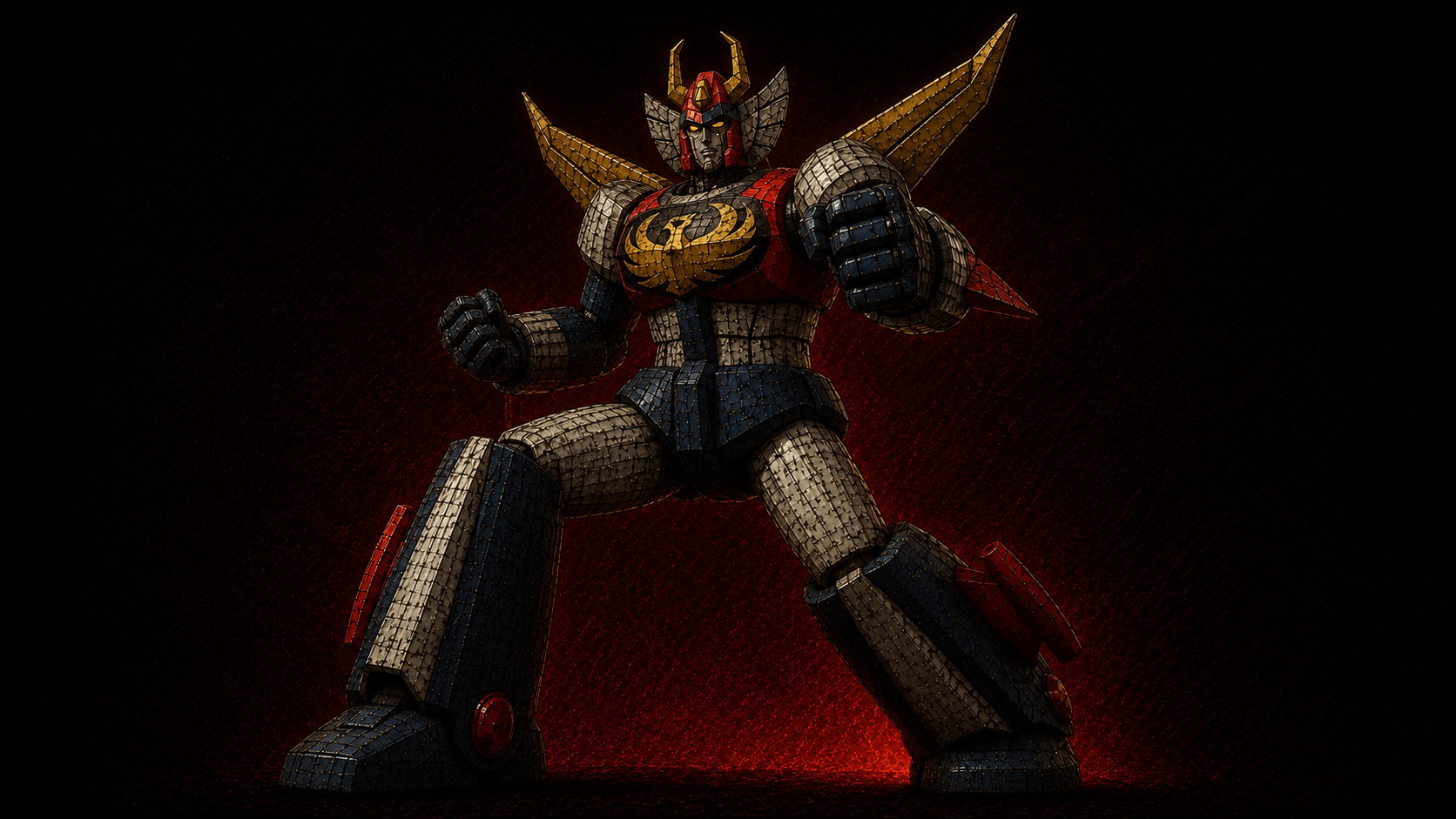
Trider G7 — the robot stored beneath a playground
— Physical Characteristics —
Height
57 meters
Weight
777 tons
Flight Capability
Capable of reaching supersonic speeds in atmosphere; functional in the vacuum of space
Cold Resistance
High resistance to cold-based attacks — capable of continued operation even when partially frozen
Navigation
Searchlights in each eye for navigation in dark environments including deep space
Transformation Mode 1 — Robot
Standard humanoid combat mode — primary configuration for ground and air battles
Transformation Mode 2 — Trider Cosmic
Ship-like spacecraft mode for high-speed flight and space travel — can fire missiles from each side of its forward hull. Docks with the Trider Shuttle for interstellar operations
Transformation Mode 3 — Trider Eagle
Bird-form flight mode — head transforms into an eagle configuration for aerial high-speed maneuvers
Additional Modes
Trider G7 is documented as having seven distinct transformation states — the full range was never completely replicated by any toy version
Trider Caterpillar
Optional land combat attachment — a tank caterpillar that connects to Trider G7 for ground operations; limits the robot to Vulcan Missiles only while equipped
Trider Marine
Small submarine stored within Trider G7 — used only in episode 44 for underwater operations
— Combat Characteristics —
Trider Bird Attack
Signature finishing move — the bird emblem on Trider G7's chest transforms into a being of pure energy that encases the entire robot. Trider G7 then rams into the enemy at full speed like a giant blade, destroying it. The most powerful attack in the series
Trider Sabers
A sword concealed in each leg — primary close-combat melee weapons
Trider Cutters
Large shuriken stored in each hip — can be thrown individually or attached to the Trider Lure for combined attacks
Trider Javelin
Yari-style spear stored in the right leg — thrown as a ranged melee weapon
Trider Chain
Throwing chain stored in the right leg — used to immobilize or drag enemies
Trider Lure
Pistol-like harpoon gun with the harpoon on a long tether — used for grappling, restraining, or pulling enemies; can combine with the Trider Cutters
Trider Beam Cannon
Beam pistol stored at the right waist — precision ranged energy weapon
Trider Missiles
Powerful missiles launched from each hip — the weapon most frequently complained about by accountant Kakikōji due to their cost
Vulcan Missiles
Rapid-fire missile system available in Trider Caterpillar configuration
Financial Note
Every weapon discharge has a documented cost that the Takeo General Company must account for — missile costs, repair bills, and operational expenses are recurring plot elements throughout the series
The Trider Bird Attack is one of the most visually distinctive finishing moves in 1980s super robot anime — the chest emblem becoming a living energy being that encases the entire robot before impact is a concept that anticipates the aura-based attacks of later series. More significantly, it is thematically connected to the bird motif of Trider G7's design, giving the finishing move a visual logic that most super robot attacks of the era lacked.
— Narrative Classification —
Setting
Contemporary Japan — Watta lives a double life as an elementary school student and company president, with robot combat interrupting both his schoolwork and his business operations
Alignment
Heroic — operating as a private defense contractor rather than a government or military organization
Central Conflict
The Robot Empire — a galactic conquering force led by Lord Zakuron — has targeted Earth for colonization. Trider G7, designed by an Empire exile with the knowledge of their invasion plans, is Earth's only defense
Primary Antagonist
Lord Zakuron — supreme commander of the Robot Empire's Earth invasion force
Narrative Theme
Coming-of-age responsibility — Watta is thrust into an adult world of business management, financial pressure, and mortal combat at age 12. The series tracks his growth from a reckless boy into someone who genuinely understands what it means to carry responsibility for others. His graduation from elementary school at the series' end marks his completion of this arc
Ending
The series concludes with Watta's graduation from elementary school — the narrative arc is explicitly the story of a boy growing up, not merely a story of defeating an enemy. The Robot Empire's defeat is secondary to Watta's personal development
— Original TV Series Information —
Title
無敵ロボ トライダーG7 (Muteki Robo Toraidā Jī Sebun)
Broadcast Network
TV Asahi
Broadcast Period
February 2, 1980 – January 24, 1981
Episodes
50
Runtime
~25 minutes per episode · Aired Saturdays 17:30–18:00 JST
Opening Theme
「トライダーG7のテーマ」(Trider G7 no Theme) — Isao Taira
Narration
Ichirō Nagai — who also provided narration for Mobile Suit Gundam, connecting the two Sunrise productions
International Release
- Italy — 1981, broadcast as L'Indistruttibile Robot Trider G7 with Italian theme song by Superobots
- No North American broadcast release
Home Media
DVD boxset released in Japan (2005) · Italian boxset with both Italian dub and original Japanese audio (2012)
Super Robot Wars
Featured in Shin Super Robot Wars (PlayStation) and the Super Robot Wars Z metaseries — frequently paired with Zambot 3 and Daitarn 3 in crossover combination attacks
— Main Characters —
Watta Takeo
Pilot of Trider G7 and second president of the Takeo General Company; 12 years old, sixth grade elementary school student. Inherits both roles upon his father's death — refusing to let the company dissolve and the robot go unused. Reckless and energetic but genuinely courageous; his character arc is the emotional core of the series. Voice: Satomi Majima
Umemaru Kakikōji
Executive director and de facto operations manager of the Takeo General Company; 64 years old. The company's primary financial voice — immediately calculates the cost of every missile fired during battle and frequently screams at Watta about operational expenses. Despite his constant complaints, he is fiercely loyal to Watta. Voice: Ichirō Nagai
Tetsuo Atsui
Managing director and the company's sole mechanic — responsible for repairing Trider G7 as well as routine maintenance tasks like fixing the office air conditioner. Pilots the Trider Shuttle and provides aerial support. Adopts a foster son named Ryuusuke during the series
Tōhachirou Kinoshita
Sales manager whose actual workload is minimal due to the company's unusual structure. The office's mood-maker — impossible to dislike despite his frivolous nature
Ikue Sunabara
The company's sole female employee, 18 years old — handles accounting, office work, and general administration. The practical anchor of the company's daily operations. Voice: Keiko Han
Professor Nabalon
Scientist exiled from the Robot Empire who defected to Earth and co-designed Trider G7 with Watta's father. His insider knowledge of the Robot Empire's technology and plans was essential to building a robot capable of defeating them
Lord Zakuron
Supreme commander of the Robot Empire's Earth invasion force — the primary antagonist of the series
— Legacy —
Genre Classification
Super Robot / Comedy / Coming-of-age
Historical Position
The first super robot anime to systematically treat giant robot combat as a business operation — introducing financial accountability, operational costs, and client relationships into a genre that had never considered the economics of saving the world
Known As
- The robot whose head is a playground jungle gym
- The super robot series with an accountant as a supporting character
- The third entry in Sunrise's Invincible Trilogy
Industry Impact
Trider G7 pioneered the blend of super robot action with workplace comedy and coming-of-age drama — a formula that influenced subsequent Sunrise productions. Its realistic treatment of robot deployment (public evacuation announcements, financial costs, repair downtime) anticipated the more grounded approach to mecha operations that became central to Real Robot series later in the decade
Collector Toys
- Clover diecast toy (1980) — original toy produced during the series' run; no version ever replicated all seven transformation modes
- Bandai Super Mini-Pla Trider G7 (2020s) — model kit set with Trider Eagle and Trider Cosmic transformation modes
— OPENING —