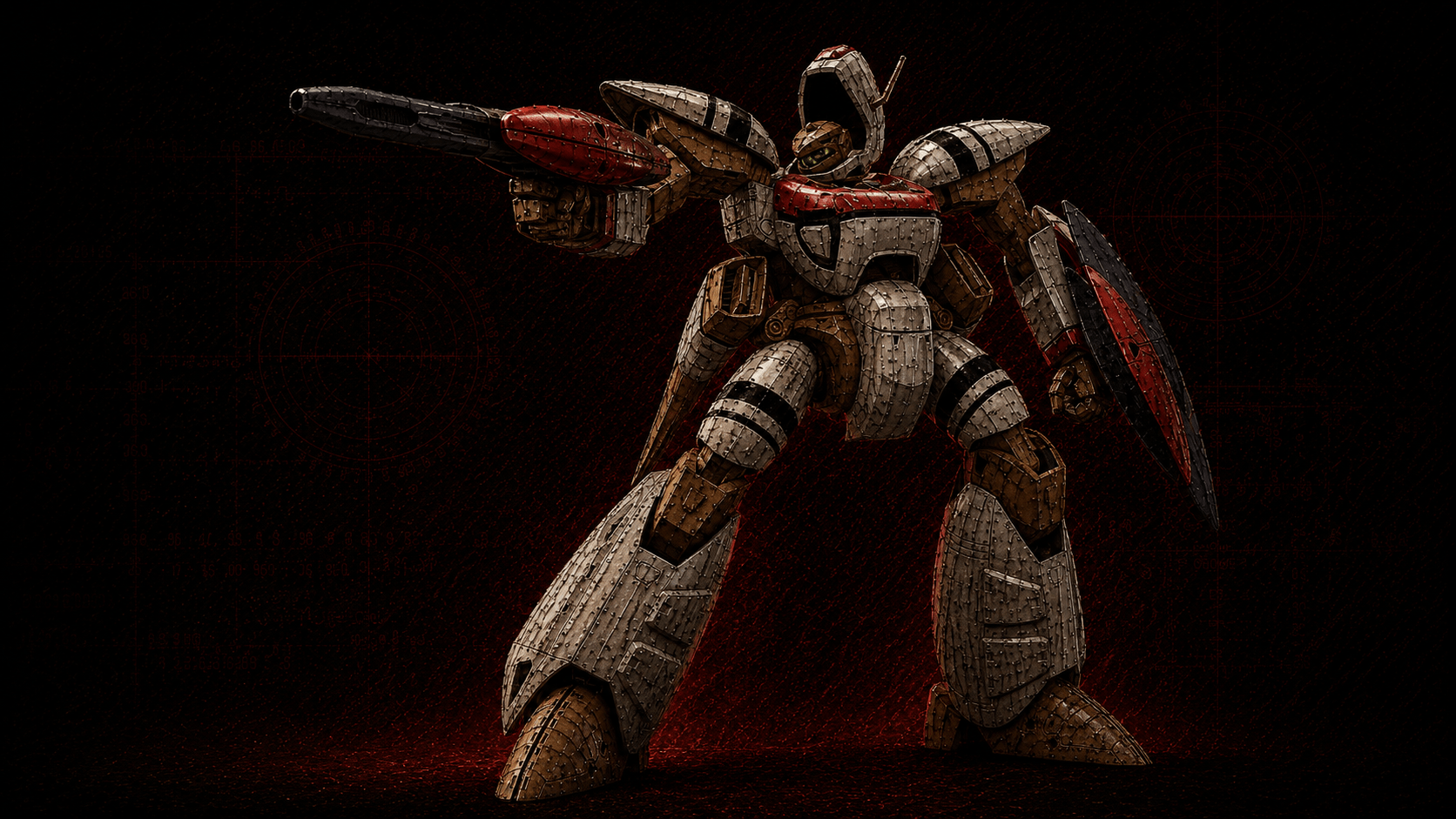
— IDENTITY —
Full Name
Chōjikū Seiki Ōgasu (超時空世紀オーガス) / Super Dimension Century Orguss
Type
Variable Fighter — transforming vehicle-type mecha (four-stage transformation)
Creator
Original concept: Studio Nue; Character design: Haruhiko Mikimoto; Mechanical design: Kazutaka Miyatake
Debut
July 3, 1983
Country of Origin
Japan
Original Medium
Anime (TV series) — an original Studio Nue concept produced as the follow-up to Super Dimension Fortress Macross
Publisher
N/A — original anime produced by Tokyo Movie Shinsha (TMS) with Artland
Genre
Science fiction / real robot drama
— DEVELOPMENT HISTORY —
Project Designation
Orguss — variable fighter combining Emaan arm technology with Chiram leg-mecha technology
Original Designer (Story)
Studio Nue (original concept); series composition by Kenichi Matsuzaki, with cooperation from Kazutaka Miyatake and Hiroshi Onogi
Construction Purpose
Within the story, Orguss was built by fusing arm-mecha technology from the Emaan faction with the leg-mecha technology of Chiram's "Bronco II" walker fighter — a hybrid born from two warring factions' engineering
Activation Method
Conventionally piloted; transforms across four stages depending on combat needs
Historical Significance
Produced as the second entry in the "Super Dimension" series following the runaway hit Super Dimension Fortress Macross, retaining several of its key staff (chief director Noboru Ishiguro, mechanical designer Kazutaka Miyatake) but aimed at an older audience with a more adult, morally complex story
— CONTROL SYSTEM —
Primary Operator
Kei Katsuragi
Control Method
Conventionally piloted variable fighter
Pilot Location
Onboard cockpit
Cockpit
Not documented in further detail in available sources
Autonomy
None — always piloted
Command Authority
Kei Katsuragi, formerly of the Freedom Space Corps, operating independently as a "Singularity" pursued by both warring factions
— PHYSICAL CHARACTERISTICS —
Robot Class
Variable fighter, four-stage transformation type
Body Structure
Transforms between Orguloid (humanoid combat mode), Flyer (high-speed flight mode), Gawalk (intermediate walker mode), and Tank (ground combat mode)
Head Design
Not detailed in depth in available sources
Visual Characteristics
Kei's unit is finished in white with a single red accent point; its joints are colored brown, an unusual choice fans have noted as distinctive among robot designs of the era
— POWER SYSTEM —
Primary Energy Source
Not documented in detail in available sources
Armor Material
Not documented in detail in available sources
Manufacturing Material Origin
Built from a fusion of Emaan and Chiram military technology
Energy Concept
A limit on maximum altitude exists throughout the story due to the distortions of the chaotic spacetime the characters inhabit, restricting Orguss and other flight-capable mecha from high-altitude operation
— COMBAT CHARACTERISTICS —
Primary Combat Style
Multi-role combat, switching between flight, ground, and melee-capable humanoid forms depending on the battlefield
Signature Weapons
Beam weapons and missile armaments in its later-generation successor Orguss II; specific armament details for the original Orguss unit are not fully documented in available sources
Mission Profile
Survival and combat support for Kei Katsuragi as he is pursued by the rival Emaan and Chiram factions across a fractured, multi-dimensional Earth
Operational Environment
Aerial, ground, and close-quarters combat across the patchwork parallel worlds of the "Realm of Mutual Conflict"
— ASSOCIATED ORGANIZATIONS —
Affiliation
Formerly the Freedom Space Corps; later an independent operator pursued by both major factions
Role
Sole variable fighter piloted by the story's "Singularity," a key to restoring the fractured timeline
Primary Enemy
Both the Emaan and Chiram factions, who pursue Kei for his singularity status
Enemy Organization
Emaan and Chiram, two rival powers at war twenty years after the spacetime disaster that created the "Realm of Mutual Conflict"
Major Threats
Military forces of both Emaan and Chiram, whose ongoing war forms the central conflict of the series
— ORIGINAL ANIME / TV SERIES INFORMATION —
Title
Super Dimension Century Orguss (超時空世紀オーガス)
Broadcast Period
July 3, 1983 – April 8, 1984
Episodes
35
Network
TBS network (via Mainichi Broadcasting)
Production Company
Tokyo Movie Shinsha (TMS), with Artland
Director
Noboru Ishiguro and Yasumi Mikamoto (Series Directors)
Runtime
Approx. 25 minutes per episode — Sundays, 14:00–14:30
In the year 2062, Earth is split between two factions fighting over control of an orbital elevator. During a botched attack, pilot Kei Katsuragi detonates a malfunctioning "space-time vibration bomb" against orders, shattering spacetime itself and merging countless parallel worlds into a single fractured reality known as the "Realm of Mutual Conflict." Thrown twenty years into a future ruled by two new warring powers, Emaan and Chiram, Kei is identified as a "Singularity" — the key to undoing the damage he caused — and is hunted by both sides as he pilots Orguss toward putting the world back together.
— MAIN CHARACTERS —
Kei Katsuragi
Former Freedom Space Corps pilot whose reckless detonation of a space-time bomb shatters reality itself. A womanizing free spirit with genuinely gifted piloting skills, he spends the series taking responsibility for the chaos he caused, piloting Orguss across the fractured timeline.
The Emaan Faction
One of two rival powers at war twenty years after the spacetime disaster, whose arm-mecha technology forms half of Orguss's design.
The Chiram Faction
The other of the two rival powers, whose "Bronco II" leg-mecha walker technology forms the other half of Orguss's design.
— LEGACY —
Historical Position
The second entry in the "Super Dimension" series, produced as a direct follow-up to the runaway success of Super Dimension Fortress Macross
Genre Innovation
Pushed its "Super Dimension" predecessor's real-robot sensibilities toward darker, more morally ambiguous storytelling aimed at an older audience, resulting in a demanding tone that proved difficult for younger viewers and toy sales alike
Relationship to Previous Mecha
Shares key creative staff with Macross, including chief director Noboru Ishiguro and mechanical designer Kazutaka Miyatake, and Orguss's four-stage transformation echoes the variable-fighter concept Miyatake helped pioneer
Industry Impact
Its commercial struggles are frequently cited by fans and historians as an example of a "Super Dimension" sequel that prioritized ambitious storytelling over the toyetic appeal that drove Macross's success
International Recognition
Received a direct sequel, Super Dimension Century Orguss 02, as a six-episode OVA beginning in 1993; Orguss and its successor Orguss II remain a recurring presence in the Super Robot Wars game franchise
— OPENING —
— COLLECTIBLES —
Megahouse
Variable Action
Super Dimension Century Orguss Figure
Buy on Amazon →