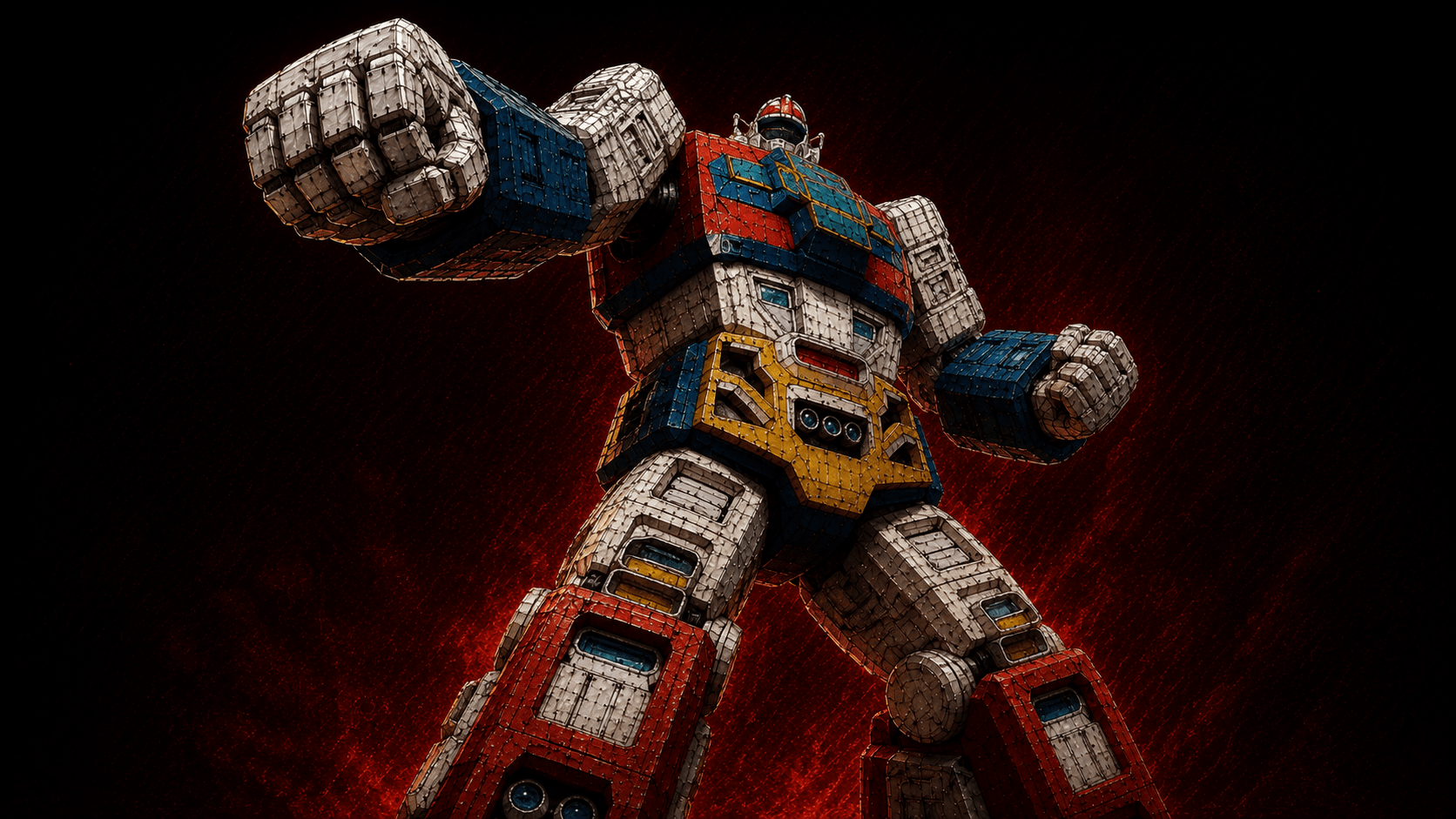
— IDENTITY —
Full Name
Video Senshi Razarion (ビデオ戦士レザリオン) / Video Warrior Laserion
Type
Super robot — transmission-materialized combat robot ("Denso Robo")
Creator
Original character concept: Shinji Imura; Character design: Hideyuki Motohashi; Mechanical design: Hatsuo Obara, Kōichi Ōhata, and Akira Hio
Debut
March 4, 1984
Country of Origin
Japan
Original Medium
Anime (TV series) — an original Toei concept, not adapted from a prior manga
Publisher
N/A — original anime produced by Toei's TV Division (planning) and Toei Animation (production)
Genre
Super robot, with computer-network and video game themes drawn from the 1983 film WarGames
— DEVELOPMENT HISTORY —
Project Designation
Laserion — the strongest transmission robot, materialized from a matter-transmission accident
Original Designer (Story)
Within the story, Laserion's program was originally written by protagonist Takashi Katori for a video game, and became real after crossing with Dr. Blueheim's matter-transmission experiment
Construction Purpose
Materialized by accident rather than deliberately built; Takashi is inducted into the Earth Federation Army's Secret Force after destroying a lunar rebel invasion force and proving to be the only person able to operate it
Activation Method
Assembled from its component Laser Frame and Laser Units within a computer-generated "digital world" before being deployed into reality — a distinctive feature the show's official materials note as unlike other giant robot works
Historical Significance
The ninth and final entry in Toei's robot anime lineage beginning with Super Electromagnetic Robo Combattler V (1976). Broadcasting shifted from TV Tokyo to TBS for this final installment, and its ad agency changed from Toei Agency to Asahi Tsūshinsha, while mechanical designers Hatsuo Obara, Kōichi Ōhata, and Akira Hio, composer Chūmei Watanabe, and Series Director Kōzō Morishita all carried over from the previous entry, Lightspeed Electroid Albegas
— CONTROL SYSTEM —
Primary Operator
Takashi Katori — the only person able to operate Laserion
Control Method
Conventionally piloted once materialized
Pilot Location
Onboard cockpit
Cockpit
Not documented in further detail in available sources
Autonomy
None — always piloted, and only by Takashi Katori
Command Authority
Earth Federation Army's Secret Force, which formally inducts Takashi after Laserion's first battle
— PHYSICAL CHARACTERISTICS —
Robot Class
Super robot, transmission-materialized type
Body Structure
Composed of a Laser Frame and Laser Units, assembled from data within a computer-generated space before appearing in the physical world
Head Design
Not detailed in depth in available sources
Visual Characteristics
Known for an unconventional design rendered through hand-drawn animation that deliberately imitated CG-style effects — a technical approach that drew significant attention at the time, especially in the finale, which featured legendary animators including Yoshinori Kanada
— POWER SYSTEM —
Primary Energy Source
Not documented in detail in available sources
Armor Material
Not documented in detail in available sources
Manufacturing Material Origin
Materialized through Dr. Blueheim's matter-transmission system, rather than conventionally manufactured
Energy Concept
Data-transmitted additional armor, commonly called "Full Armor," was developed and transferred to Laserion via command input to counter the Jark Empire's equally transmission-capable robot, Gallio Saban
— COMBAT CHARACTERISTICS —
Primary Combat Style
Began with a harder, real-robot-influenced tone in its first half before shifting toward a more conventional super robot style in its second half
Signature Weapons
Not documented in detail in available sources
Mission Profile
First-half combat against a lunar-based rebel army led by Dr. Godhide; second-half defense of Earth against invaders from the Jark Empire
Operational Environment
Ground, lunar, and space combat across both halves of the series
— ASSOCIATED ORGANIZATIONS —
Affiliation
Earth Federation Army's Secret Force
Role
Sole robot piloted by Takashi Katori, Earth's primary defense against both the lunar rebels and the Jark Empire
Primary Enemy
Dr. Godhide's lunar rebel army in the first half; the invading Jark Empire in the second half
Enemy Organization
The Jark Empire, whose emperor shares a voice actor with Dr. Godhide in the original Japanese cast
Major Threats
Gallio Saban, a Jark Empire robot with matter-transmission capability equal to Laserion's own, piloted by a rival introduced in the second half
— ORIGINAL ANIME / TV SERIES INFORMATION —
Title
Video Warrior Laserion (ビデオ戦士レザリオン)
Broadcast Period
March 4, 1984 – February 3, 1985
Episodes
45
Network
TBS network
Production Company
Toei Animation (Toei TV Division planning, Toei Doga production)
Director
Kōzō Morishita (Series Director)
Runtime
Approx. 25 minutes per episode — Sundays, 17:00–17:30
Computer-obsessed teenager Takashi Katori writes a robot program for a video game he's designing. Through a freak accident, his program crosses with Dr. Blueheim's experimental matter-transmission system, and the strongest transmission robot ever created, Laserion, materializes into reality. After Takashi single-handedly destroys an invading force from a Moon-based rebel army, and it becomes clear he is the only person capable of piloting it, he is formally inducted into the Earth Federation Army's Secret Force. The story's title references "video games," and its themes of computer networks and digital infiltration were directly inspired by the 1983 film WarGames.
— MAIN CHARACTERS —
Takashi Katori
Computer-loving teenager whose video game robot program accidentally materializes as Laserion. The only person able to pilot it, and formally inducted into the Earth Federation Army's Secret Force.
Dr. Blueheim
Scientist whose matter-transmission experiment inadvertently gives rise to Laserion when it crosses with Takashi's game program.
Olivia
Member of the Secret Force alongside Takashi.
Dr. Godhide
Leader of the Moon-based rebel army that Laserion first battles in the series' first half.
The Jark Empire
Invaders from outside Earth who become the series' primary antagonists in its second half, fielding the rival transmission robot Gallio Saban.
— LEGACY —
Historical Position
The ninth and final entry in Toei's robot anime lineage that began with Combattler V in 1976, closing out nearly a decade of continuous production
Genre Innovation
Built its premise around then-cutting-edge computer network and video game themes, directly inspired by the 1983 film WarGames — an unusually contemporary framing device for a super robot show of its era
Relationship to Previous Mecha
Directly continued key creative staff from its immediate predecessor Lightspeed Electroid Albegas, including mechanical designers Hatsuo Obara, Kōichi Ōhata, and Akira Hio, composer Chūmei Watanabe, and Series Director Kōzō Morishita
Industry Impact
Its unconventional hand-drawn animation, engineered to mimic CG-style effects, drew particular attention in its finale, which brought together legendary animators including Yoshinori Kanada
International Recognition
Long unavailable on home video, it did not receive a DVD release until 2020, decades after broadcast, reflecting its comparatively lower profile relative to other entries in Toei's robot anime lineage
— OPENING —