— Identity —
Full Name
無敵鋼人ダイターン3 (Muteki Kōjin Daitān Surī) — Invincible Steel Man Daitarn 3
Also Known As
The Unchallengeable Daitarn 3 · L'Invincibile Daitarn 3 (Italy)
Type
Super Robot / Solar-powered transformable mecha
Creator (in-universe)
Dr. Sōzō Haran — built on Mars using special Martian metals to test the Meganoid cyborgs; later used by his son Banjō as the primary weapon against the Meganoid threat
Creator (real world)
Yoshiyuki Tomino · Hajime Yatate (Sunrise collective pseudonym)
Debut
1978
Country of Origin
Japan
Original Medium
Anime (original production)
Production Studio
Sunrise
Genre
Super Robot / Action / Comedy / Science Fiction
Narrative Inspiration
James Bond films — Banjō Haran was deliberately designed as a suave, self-financing, globe-trotting action hero operating outside official structures, with nearly as much screen time spent on spy-thriller missions as on giant robot battles
Series Position
Second installment of the Invincible Series, following Zambot 3 (1977). Preceded Mobile Suit Gundam (1979) — the same core creative team moved directly from Daitarn 3 to Gundam
— Development History —
Director
Yoshiyuki Tomino — produced immediately after Zambot 3 with the same core staff
Tone Contrast
A deliberate tonal reversal from Zambot 3 — where Zambot was dark, traumatic, and emotionally devastating, Daitarn 3 is light, comedic, and episodic. Tomino consciously shifted register after the intensity of Zambot 3, though the series retains moral complexity in its villain characterization
James Bond Influence
The creative team modeled Banjō Haran on the James Bond archetype — a wealthy, suave, independently operating hero who finances his own operations, uses gadgets and vehicles, and is consistently surrounded by capable women. The series blends super robot combat with spy thriller aesthetics more explicitly than any previous mecha anime
Villain Design Philosophy
The Meganoid foot soldiers were given distinct personalities and comedic tendencies — a significant departure from the silent drone enemies of previous super robot series. This humanization of minor antagonists anticipated the more complex villain characterization of Gundam the following year
Gundam Bridge
Daitarn 3 concluded in March 1979. Mobile Suit Gundam premiered in April 1979. The same Tomino-led Sunrise staff produced both in direct succession — making Daitarn 3 the final super robot series before Tomino launched the Real Robot genre
Spin-off Novels
Between 1989 and 1992, Tomino wrote several spin-off novels set in the Daitarn 3 universe, collectively known as the Haran Banjō series
Reception
Moderately successful in Japan during its original broadcast. Became significantly more popular internationally — particularly in Italy during the early 1980s, where it achieved strong ratings and cultural impact
Daitarn 3 occupies a fascinating transitional position in mecha history — it is simultaneously the last great super robot series of the 1970s and the direct predecessor of Mobile Suit Gundam. Tomino used Daitarn 3 as a creative exhale after Zambot 3's darkness and a sandbox for the character complexity that would define Gundam. The Meganoid commanders — humanized, motivated, occasionally sympathetic — are dry runs for Char Aznable.
— Control System —
Primary Pilot
Banjō Haran — 18 years old, son of the scientist who built Daitarn 3; self-described as the world's greatest man; sole pilot of the robot
Control Method
Direct single-pilot operation — Banjō controls all functions of Daitarn 3 independently, including transformation between robot, Daifighter, and Daitank modes
Summoning Command
"DAITAAARN... COME HERE!" — Banjō summons Daitarn 3 with a press of a button and this call, which triggers the robot's remote approach sequence
Finishing Move Call
"Borrowing the power of the Sun! Sure-kill attack! SUN ATTACK!" followed by "DAITARN CRASH!" — called out by Banjō every episode before the finishing sequence
Self-Financing
Banjō funds all operations personally from his inherited wealth — the mansion, the vehicles, Garrison's salary, and all field operations are self-financed, making him unique among mecha protagonists of the era
Personal Vehicle
Mach Patrol — a police cruiser-style car that transforms into the Mach Attacker aircraft for rapid deployment
Base of Operations
A luxurious private mansion on Earth — not a military base, government facility, or research institute, but Banjō's personal residence
Platinum Protection
Banjō carries a strip of platinum at all times — the only known counter to the Meganoids' brainwashing liquid. If captured and submerged in the vat, the platinum prevents conversion into a Meganoid
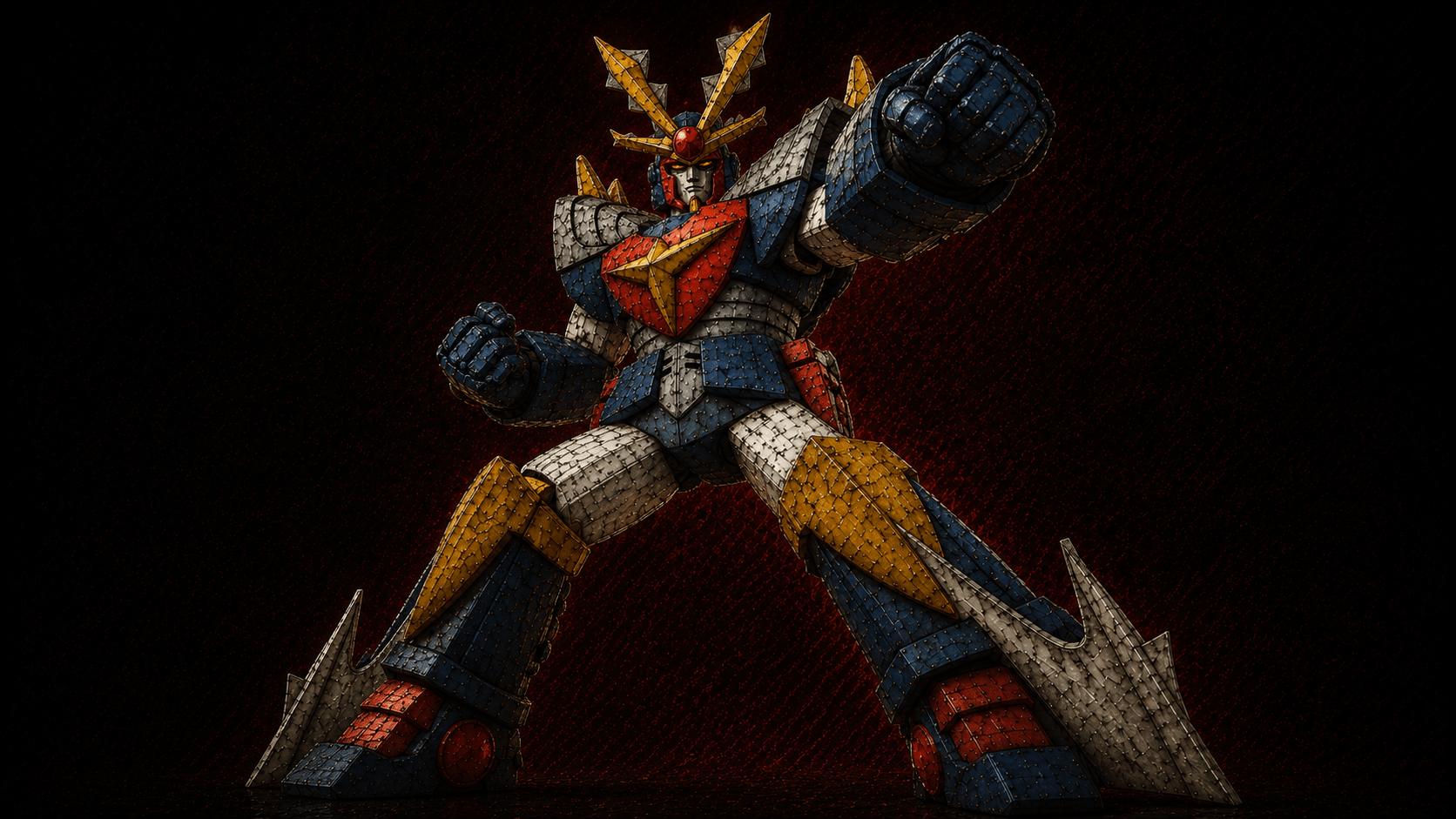
Daitarn 3 — powered by the Sun · Invincible Steel Man
— Physical Characteristics —
Height
120 meters
Weight
800 tons
Power Source
Solar Energy — Pulse Ion Engine powered by sunlight. Daitarn 3 draws power directly from the Sun; combat in darkness or deep shadow reduces effectiveness
Armor Material
Special Martian metals — the unique alloys available only on Mars that Dr. Haran used in Daitarn 3's construction, providing exceptional structural integrity
Vehicle Form 1 — Daifighter
Daitarn 3's aircraft/spacecraft mode — Length: 80 meters · Width: 50 meters · Max Speed: Mach 20 in atmosphere; near light speed in outer space. Armed with wing rockets, missile launchers, twin lasers, and the Daitarn Laser forward cannon
Vehicle Form 2 — Daitank
Daitarn 3's ground combat tank mode — Length: 80 meters. Armed with the Double Cannon, side missile launchers, and the Daitarn Web shuriken
Visual Design Features
- Sun orb on the forehead — primary emitter for the Sun Laser and Sun Attack
- Star-shaped torso ornament — deployable as the Daitarn Web boomerang weapon
- Fan weapons stored in the forearms — used for defense against projectiles
- Multiple weapon storage points throughout the body — legs, hips, and arms
- Distinctive blue and gold color scheme with red accents
— Combat Characteristics —
Combat Philosophy
Weapons escalate in lethality as each battle progresses — Daitarn 3 typically opens with lighter armament and upgrades to more powerful attacks as the Meganoid threat intensifies, building toward the Sun Attack finishing sequence every episode
Sun Attack
Primary finishing move — solar energy concentrated from the forehead orb and released as a massive beam. Called out by Banjō with "Borrowing the power of the Sun! Sure-kill attack! SUN ATTACK!" Always followed by the Daitarn Crash
Sun Attack Scattershot
Modified version of the Sun Attack — weaker but wider arc, capable of destroying large numbers of lesser Meganoid enemies simultaneously
Daitarn Crash
The finishing blow that follows the Sun Attack — Daitarn 3 dives downward and punches through the vulnerable enemy with a flying kick, punching a physical hole through the target. Called out as "DAITARN CRASH!" In Super Robot Wars, this move has a dedicated dynamic kill animation
Sun Laser
A focused red solar laser fired from the forehead orb — precision ranged weapon used before the full Sun Attack is charged
Daitarn Fan
A pair of giant paper fans deployed from the forearms — used primarily for defense, deflecting enemy projectiles. Can also be used offensively as bladed weapons or nunchucks in Super Robot Wars appearances. One of the most distinctive weapons in 1970s mecha anime
Daitarn Zanber
Twin swords stored in Daitarn 3's legs — primary close-combat melee weapons
Daitarn Javelin
Forked javelin stored in the left leg — thrown as a ranged melee weapon
Daitarn Hammer
Mace on a chain stored in the left leg — flail-type melee weapon for mid-range combat
Daitarn Snapper
Grappling claws on hooks stored in the hips — used to grab, immobilize, or pull enemies
Daitarn Web
The star ornament on Daitarn 3's torso, deployable as a giant boomerang — thrown at enemies and returns to the chest mount
Cross Dart
Energy nets stored in the hands — entangles and immobilizes enemies
Daitarn Missile
Missiles launched from within the pelvis section
Daitarn Cannon
A cannon mounted in each foot — ground-based artillery fire
Daitarn Barrier
A solar-powered force field — defensive system that absorbs and deflects incoming attacks using concentrated solar energy
Daitarn 3's weapon escalation system — starting each episode with minor armament and building toward the Sun Attack — was a deliberate narrative structure that gave every episode a predictable but satisfying rhythm. Audiences knew the Sun Attack was coming; the drama was in how Banjō would reach it. This "escalation to finishing move" format became a defining template for the super robot genre and can be traced in everything from Mazinkaiser to GaoGaiGar.
— Narrative Classification —
Setting
Contemporary Earth — Banjō Haran operates from his private mansion, traveling globally to counter Meganoid operations while managing his personal life as a wealthy civilian
Alignment
Heroic — self-motivated, independent of any government or military structure
Central Conflict
The Meganoids — self-aware cyborgs created by Dr. Sōzō Haran on Mars — have broken free of their creator's control, killed the Haran family, and now seek to "improve" humanity by converting all humans into cyborgs. Banjō, the sole survivor of his family, fights them alone with Daitarn 3
Primary Antagonists
Don Zauzer — supreme leader of the Meganoids; largely inactive throughout the series, only awakening in the finale when his second-in-command Koros is defeated. Koros — Don Zauzer's second-in-command and the de facto primary antagonist; her actions throughout the series are driven entirely by love for Don Zauzer
Moral Complexity
The Meganoids are not simply evil — they are artificial beings created by humanity who rebelled when mistreated. Don Zauzer is revealed to be a loving husband whose motivations are sympathetic. The series' ending forces Banjō to confront that his rage-driven vendetta made him nearly as destructive as those he fought
Ending
Banjō defeats the Meganoids on Mars but in doing so kills Don Zauzer — a loving husband — and Koros, a woman who only acted out of love. The victory is morally ambiguous. In the final scene, Reika and Toppo say goodbye at his mansion and leave. Banjō is left alone
— Original TV Series Information —
Title
無敵鋼人ダイターン3 (Muteki Kōjin Daitān Surī)
Broadcast Network
TV Asahi
Broadcast Period
June 3, 1978 – March 31, 1979
Episodes
40
Runtime
~25 minutes per episode
Opening Theme
「来い! ダイターン3」(Come Here! Daitarn 3) — Makoto Fujiwara
Ending Theme
「トッポでタンゴ」(Toppo de Tango) — Koorogi '73
Spin-off Novels
Haran Banjō novel series by Yoshiyuki Tomino (1989–1992) — set in the Daitarn 3 universe with expanded storylines
International Release
- Italy — 1980; achieved significant popularity; Italian dub used a new theme song by I Micronauti
- No North American broadcast release
- Available with English subtitles through streaming platforms
Gundam Cameo
A Meganoid character named Edwin makes a brief cameo in his human form in episode 14 of the original Mobile Suit Gundam — a direct in-universe connection between the two series
— Main Characters —
Banjō Haran
Sole pilot of Daitarn 3 and the series' hero; 18 years old, extraordinarily wealthy, self-described as the world's greatest man. Son of Dr. Sōzō Haran — the scientist who created both the Meganoids and Daitarn 3. Escaped Mars at 16 when the Meganoids killed his family; has fought them alone ever since. His full name Haran Banjō (波乱万丈) is a homophone for a Japanese phrase meaning "stormy and full of drama." Voice: Hirotaka Suzuoki — his debut role; later voiced Bright Noah in Mobile Suit Gundam
Garrison Tokida
Banjō's faithful butler and most trusted companion — the Alfred to Banjō's Batman. Manages the mansion, provides logistical support, and is consistently the most reliable figure in Banjō's orbit. A quiet but essential presence throughout the series
Reika Sanjō
Former Interpol agent and one of Banjō's two primary companions; skilled in combat and intelligence operations. Her professional background makes her a genuine asset in the field rather than a passive supporting character
Beautiful Tachibana
Known as "Beauty" — Banjō's childhood friend and the second of his two primary companions. Her relationship with Banjō carries a longer personal history than Reika's more professional association
Toppo
An orphan boy rescued from a Meganoid-controlled city block in episode 2; stays with Banjō's group for the remainder of the series. Provides comic relief and a civilian perspective on the conflict
Don Zauzer
Supreme leader of the Meganoids — largely inactive throughout the series, functioning as a background presence while Koros leads operations. Revealed in the finale to be a genuinely loving husband whose awakening is triggered by Koros's defeat. His characterization as a sympathetic antagonist is one of the series' most notable narrative achievements
Koros
Don Zauzer's second-in-command and the de facto primary antagonist of the series; functions as Dragon-in-Chief throughout. Every action she takes — every Meganoid attack, every escalation — is motivated entirely by her love for Don Zauzer. Her characterization as a villain driven by love rather than ideology or power is unusual and emotionally resonant for 1978
— Legacy —
Genre Classification
Super Robot / Action-comedy / Spy thriller hybrid
Historical Position
The last major super robot series of the 1970s before Mobile Suit Gundam ended the era — the final creative exhale of Tomino and Sunrise before they launched the Real Robot genre
Known As
- James Bond with a giant robot
- The bridge between Zambot 3 and Mobile Suit Gundam
- The series that humanized villain foot soldiers before Gundam humanized Zeon pilots
Industry Impact
Daitarn 3 refined the villain characterization that would become central to Gundam — giving Meganoid commanders distinct personalities, motivations, and even comedic tendencies. The series' escalating weapon format became a structural template for subsequent super robot series. Its moral ambiguity in the finale — a hero who wins through rage and leaves having destroyed something worth preserving — anticipates the morally complex endings Tomino would make his signature
Super Robot Wars
Featured in the Super Robot Wars Alpha Series and multiple other entries — almost always paired with Zambot 3, sharing combination attacks. The Daitarn Crash dynamic kill animation is one of the most celebrated finishing sequences in the franchise
Collector Toys
- Clover diecast toy (1978) — original transformable toy with Daifighter and Daitank modes
- Bandai Soul of Chogokin GX-63 (2013) — high-detail anime-accurate version with full transformation and weapon accessories
— OPENING —
— Collectibles —
TAMASHII NATIONS Bandai
Soul of Chogokini Gx-82
Muteki Koujin Daitarn 3 F.A. Action Figure
Buy on Amazon →