— Identity —
Full Name
伝説巨神イデオン (Densetsu Kyojin Ideon) — Legendary Giant God Ideon
Type
Super Robot / Three-component combining mecha of ancient alien origin
Creator (in-universe)
The Sixth Civilization — an extinct alien race that built the Ideon on planet Solo to house their god, the Ide
Creator (real world)
Yoshiyuki Tomino (series creator and director) · Hajime Yatate (Sunrise collective pseudonym)
Mecha Designer
Studio Submarine / Yuichi Higuchi (TV series) · Yuichi Higuchi (theatrical films)
Character Designer
Tomonori Kogawa
Debut
1980
Country of Origin
Japan
Original Medium
Anime (original production)
Production Studio
Sunrise
Genre
Super Robot / Philosophical Science Fiction / Tragedy
Name Origin
Derived from the Greek word "Idea" with the noun suffix "-on" — meaning "a being at the peak of all things." The name also encodes the Greek letters Iota (I), Delta (D), and Epsilon (E) — representing the Ide energy. The Buff Clan calls it "the Colossus" or "the Colossus of Ide"
— Development History —
Series Context
The direct follow-up to Mobile Suit Gundam — Tomino's second consecutive series for Sunrise, produced immediately after Gundam concluded in January 1980. Premiered on TV Tokyo on May 8, 1980
Toymaker Sponsor
Tomy — who requested a robot anime incorporating a "one-touch transformation" feature popular in their previous product line. The combination system of Ideon's three vehicles was designed around this commercial requirement
Production Fate
Planned for 43 episodes but cancelled after 39 due to low ratings — the same fate as Mobile Suit Gundam. The final four episodes were produced as the theatrical film The Ideon: Be Invoked (1982), with Sanrio Animation co-producing
Theatrical Films
Two films released simultaneously on July 10, 1982: The Ideon: A Contact (85 min) — compilation of TV episodes 1–32 with newly animated scenes; The Ideon: Be Invoked (98 min) — conclusion of the story incorporating the unaired final episodes with significant changes and a catastrophic ending
Historical Significance
Ideon is one of the darkest and most philosophically ambitious works in mecha anime history — a series that begins as a conventional giant robot show and escalates into an existential tragedy about the futility of war and the indifference of cosmic forces to human survival. Its apocalyptic conclusion directly inspired Hideaki Anno's Neon Genesis Evangelion (1995), which Anno has described as "Ideon meets Devilman"
Award
Won the Animage Anime Grand Prix for the second half of 1980
Ideon begins as an almost conventional super robot show — three trucks combine into a big red robot, plucky young crew, alien invaders with ridiculous names. Tomino constructed this normalcy deliberately. The series spends its first act drawing in the viewer with familiar genre comfort before systematically dismantling it. By the final film, every major character is dead, both civilizations are annihilated, and the universe itself is destroyed and remade. No mecha anime had gone this far before. Very few have since.
— Control System —
Primary Pilot
Cosmo Yuki — a young colonist from planet Solo; the first to climb aboard one of the Ideon's component vehicles during the Buff Clan attack
Secondary Pilots
Bes Jordan (Ideo Nova) and Moera Fatima (Ideo Buster) — crew members of the Solo Ship who pilot the other two components
Control Method
Direct piloting of the three component vehicles — the combination occurs autonomously when the Ide energy activates. The pilots do not trigger the combination; the Ide does
Ide Responsiveness
The Ide energy responds more powerfully to younger pilots and to children — a key plot element as the series progresses and younger crew members become central to the Ideon's combat capability. The presence of children aboard the Solo Ship directly amplifies the Ideon's power
Ide Gauge
A gauge in the cockpit of each of the three components measuring the current level of Ide energy. Low Ide: reduced attack and defense; potential forced separation into components. High Ide: exponentially increased capabilities, barrier activation, access to the Ideon Sword and Ideon Gun. Maximum Ide: the Ideon becomes uncontrollable
Autonomy
Partial to total — at low Ide levels, the Ideon responds to pilot commands. At high Ide levels, the mecha begins to act on its own will, initiating attacks and defensive maneuvers independent of the pilots. At maximum Ide, it is completely autonomous and cannot be stopped
Carrier Vessel
Solo Ship — an ancient Sixth Civilization temple-spacecraft repurposed as the crew's mobile base; capable of faster-than-light travel via Dimension Drive
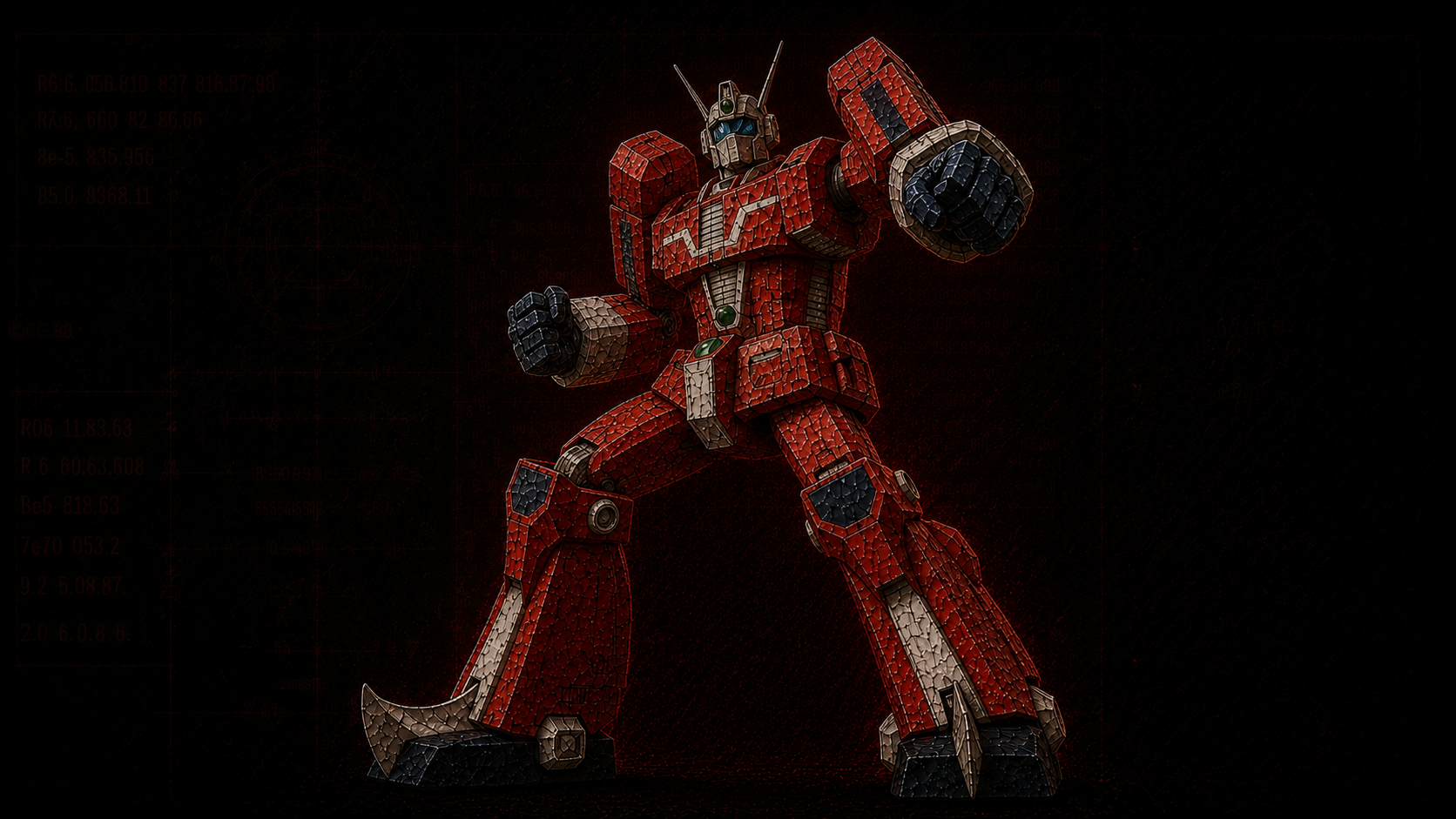
Ideon — the Legendary Giant God · power that cannot be controlled
— Physical Characteristics —
Height
105 meters
Weight
5,650 tons
Power Source
Ide — an infinite energy derived from the collective consciousness of the Sixth Civilization; effectively limitless when fully activated
Armor Material
Ideonite — not a conventional armor alloy but a material that functions as a rechargeable battery for Ide energy. At low Ide levels, the physical durability of the Ideonite is unremarkable. At high Ide levels, the Ide Barrier becomes the primary defensive system, rendering physical armor largely irrelevant
Component 1 — Ideo Delta
Sol Amber (ground mode: tank) / Ideo Delta (combat mode: spaceship) — forms the head, shoulders, and arms of the Ideon
Component 2 — Ideo Nova
Sol Vainer (ground mode: truck) / Ideo Nova (combat mode: mobile fortress) — forms the chest and torso of the Ideon
Component 3 — Ideo Buster
Sol Conver (ground mode: truck) / Ideo Buster (combat mode: spaceship) — forms the legs and lower body of the Ideon
Combination Trigger
Autonomous — the Ide activates the combination independently in response to threat. The pilots do not initiate or control the combination sequence
— Combat Characteristics —
Combat Philosophy
The Ideon is not a weapon its pilots control — it is a cosmic force that tolerates their presence. Its combat capability scales with Ide energy levels, making it unpredictable and increasingly dangerous to friend and foe alike as the series progresses
Glen Cannon
The Ideon's basic weapon system — energy cannons installed by colonist mechanic Joliver Ira after the Buff Clan attack. Available in Small, Standard, and Large versions. Power equivalent to a combat ship's main gun even at low Ide levels
All-Direction Missiles
Up to 16,000 missiles stored throughout the Ideon's body — waist (×1), shoulders (×2), legs (×2), wrists (×2), abdomen (×2), and additional ports. When Ide is fully powered, all missiles fire simultaneously in every direction, destroying entire fleets in a single barrage
Ide Barrier
An orange force field generated by Ide energy — capable of protecting both the Ideon and the Solo Ship from any attack when Ide levels are sufficient. At low Ide, the barrier fails. At high Ide, it becomes effectively impenetrable
Mini Black Hole Cannon
A waist-mounted cannon that creates a miniature black hole — used only once in the TV series (episode 18) due to the indiscriminate destruction it causes to both sides. Considered one of Ideon's weaker weapons relative to what follows
Ideon Sword
Twin beams of pure light emitted from both of Ideon's wrists — capable of cutting through planets when Ide is at maximum output. First used in episode 28. One of the two most powerful weapons in the series
Ideon Gun (Wave Leader Cannon)
The Ideon's ultimate weapon — a massive blue cannon 400 meters long and 49,000 tons, directly powered by Ide energy. Fires an enormous white destructive wave in a 45-degree arc that annihilates everything in its path including starships and planets. Its first use leaves the crew so horrified they refuse to use it again until it becomes absolutely necessary. First used in episode 28. In the final film, the fully activated Ideon Gun contributes to the destruction of the universe
The Ideon Gun's initial firing in episode 28 is one of the most significant moments in the series — not because of its destructive power, but because of the crew's reaction to it. They witness what they have unleashed and immediately agree to never use it again unless there is no other choice. This restraint in the face of overwhelming capability is central to Ideon's philosophical argument: the problem is not that humanity lacks power. The problem is that humanity cannot be trusted with it.
— Narrative Classification —
Setting
Year 2300 — humanity has colonized multiple planets across the galaxy. Planet Solo in the Andromeda Galaxy is the site of the discovery that triggers the series
Central Conflict
The Buff Clan, a militaristic humanoid civilization from the Andromeda Galaxy, pursues the Solo Ship crew across the universe seeking the Ide energy contained within the Ideon. The war begins with a misunderstanding and escalates until both civilizations are destroyed
The Ide
The Ide is not merely a power source — it is presented as an infinite life energy derived from the collective consciousness of the Sixth Civilization, with its own will and purpose. Tomino explicitly linked the Ide to Sigmund Freud's concept of the "Id" — primal, uncontrollable instinct. The Ide grows more powerful in response to conflict and threat, ultimately deciding that both humanity and the Buff Clan have failed to achieve peace and must be destroyed and reborn
Narrative Theme
The absolute futility of war — the conflict between the Solo Ship crew and the Buff Clan begins with a misunderstanding, is sustained by pride and revenge, and ends in mutual annihilation. Neither side is evil; both are trapped in escalation neither can stop. The Ide's final judgment is that humanity as a whole has failed
Ending
The Ideon: Be Invoked concludes with the total destruction of both the human and Buff Clan civilizations, the annihilation of the universe, and the dispersal of all souls toward potential rebirth in a new dimension. Every major character on both sides dies. It remains one of the most extreme endings in the history of anime
Buff Clan
The primary antagonist civilization — humanoid aliens from the Andromeda Galaxy whose desire for the Ide drives the series. Presented not as villains but as a military society with its own internal politics, family ties, and individual characters with genuine depth — many of whom the audience comes to sympathize with before they die
— Original TV Series Information —
Title
伝説巨神イデオン (Densetsu Kyojin Ideon)
Broadcast Network
TV Tokyo (Tokyo Channel 12)
Broadcast Period
May 8, 1980 – January 30, 1981
Episodes
39 (cut from planned 43)
Runtime
~25 minutes per episode
Director
Yoshiyuki Tomino
Theatrical Films
- The Ideon: A Contact (接触篇) — July 10, 1982 · 85 minutes · compilation of TV episodes 1–32
- The Ideon: Be Invoked (発動篇) — July 10, 1982 · 98 minutes · conclusion of the series with apocalyptic ending
Home Media
Sentai Filmworks / Maiden Japan — North American Blu-ray release with English subtitles; later streaming via HIDIVE
International Recognition
Largely unknown outside Japan during its original broadcast; gained a significant cult following in Western markets from the 2000s onwards following home video releases. Rated among the top 10 greatest anime series by Animage magazine
— Main Characters —
Cosmo Yuki
Primary pilot of the Ideo Delta and de facto leader of the Ideon's combat operations; a young, impulsive colonist from planet Solo who climbs into one of the Ideon's trucks during the initial Buff Clan attack with no idea what he is doing. His arc — from reckless teenager to war-hardened pilot to someone who has seen too much — is the emotional spine of the series. Voice: Katsuji Mori
Bes Jordan
Pilot of the Ideo Nova and military commander of the Solo Ship's defense forces; the most senior military figure among the survivors. His relationship with Buff Clan defector Karala — and the child she carries — becomes the central human story of the series
Karala Ajiba
Daughter of Buff Clan military commander Doba Ajiba; defects to the Solo Ship crew after investigating planet Solo against orders. Her presence aboard the Solo Ship makes her a target of both the Buff Clan and suspicious colonists. Her pregnancy with Bes Jordan's child — a union between two supposedly enemy species — embodies the series' central argument about the arbitrary nature of the conflict
Doba Ajiba
Supreme commander of the Buff Clan military and Karala's father; the series' primary antagonist — a rigid military figure whose pursuit of the Ide becomes obsessive and ultimately self-destructive. His relationship with his daughter is one of the series' most complex dynamics
Gije Zaral
Buff Clan commander initially assigned to retrieve Karala from planet Solo; one of the most developed antagonist characters in the series, whose growing respect for the Solo Ship crew and disillusionment with the Buff Clan military leads to a significant character arc across the series
Rapapa
An infant aboard the Solo Ship — one of several children whose presence aboard the vessel dramatically amplifies the Ideon's Ide output. The Ide responds most powerfully to the very young, making the ship's children unwitting weapons in the conflict
— Legacy —
Genre Classification
Super Robot / Philosophical mecha tragedy
Historical Position
One of the most philosophically ambitious mecha anime ever produced — a work that used the conventions of the super robot genre to construct an argument about the self-destructive nature of war and the indifference of cosmic forces to human suffering
Known As
- The anime that ends with the destruction of the universe
- The direct philosophical ancestor of Neon Genesis Evangelion
- Tomino's darkest work — the origin of his "Kill 'em All" reputation
Evangelion Connection
Hideaki Anno has explicitly described Neon Genesis Evangelion as "Ideon meets Devilman." The thematic parallels are extensive: a giant robot of ancient alien origin containing an unfathomable energy, pilots who cannot truly control it, an ending that destroys and remakes the world, and a deeply pessimistic view of humanity's capacity for self-destruction. Ideon is widely considered the most direct precursor to Evangelion in the mecha genre
Industry Impact
Ideon proved that a mecha anime could be genuinely tragic, philosophically serious, and willing to destroy everything — including its own audience's investment in the characters. This opened a path that Evangelion walked fourteen years later. Without Ideon, the most influential anime of the 1990s looks very different
Collector Toys
- Clover diecast toy (1980) — original combining toy produced during the series' run
- Bandai Soul of Chogokin GX-36 (2006) — high-detail anime-accurate version with all three components
- MODEROID Mini Transformable Ideon (2026) — upcoming non-scale combining model kit
— OPENING —
— Collectibles —
TAMASHII NATIONS - Space Runaway Ideon
Space Runaway Ideon - GX-92 Ideon F.A.
Bandai Spirits Soul of Chogokin Die-Cast Metal Collectible
Buy on Amazon →